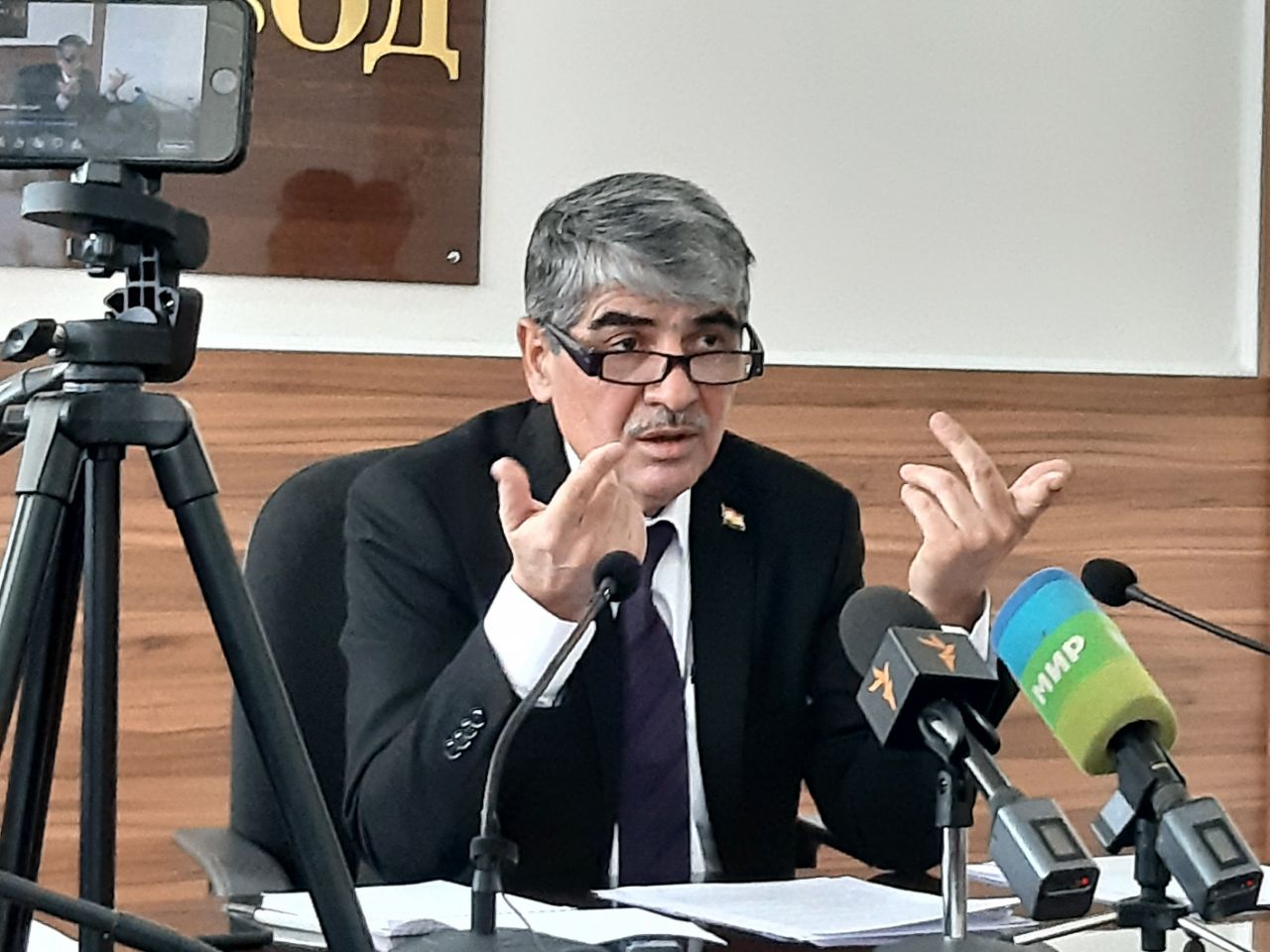
In a report released at a news conference in Dushanbe, Ilhom Atoyev, the deputy head of the Communications Service under the Government of Tajikistan, noted on July 13 that according to the preliminary data, a total income of the communications sector over the first six months of this year has amounted 1,660,509,000 somonis, which is 12,2 percent more than in the same period last year.
As of July 1, 2022, a total number of SIM cards in the country reportedly was 7,943,309, with 5,460,504 of them being active ones.
There are 4.2 million Internet users, including those using mobile Internet, in Tajikistan, Atoyev said, noting that internet speed in the country has increased.
“Over the first six months of this year, we have increased the speed of incoming Internet in Tajikistan from 70 gigabyte per second to 100 gigabyte per second,” Atoyev noted.
Meanwhile, Atoyev, speaking to reporters in Dushanbe on January 31 this year, presented these figures (regarding Internet speed) as achievements of 2021.
Answering a clarifying question by Asia-Plus reporter, Atoyev said that on January 31 they talked “about running channels to the country, while over the first six months of this year, the infrastructure has been updated and work in this area is being continued.”
The communications official also noted that more than 2.8 million SIM cards have not been reregistered on ID-passports as of June 30 this year.
“It's mostly older people who don't want to obtain ID-passports of the sample of 2014.
He further noted that reregistration of SIM cards is needed for registration of IMEI codes.
Experts say IMEI registration is necessary to reduce the number of phone thefts. According to them registration of IMEI codes will reduce the number of such crimes by 70 percent.
Besides, registration of IMEI codes will allow nullifying the phone smuggling market in the country.
The International Mobile Equipment Identity (IMEI) is a number, usually unique, to identify 3GPP and iDEN mobile phones, as well as some satellite phones. It is usually found printed inside the battery compartment of the phone, but can also be displayed on-screen on most phones by entering *#06# MMI Supplementary Service code on the dialpad, or alongside other system information in the settings menu on smartphone operating systems.
GSM networks use the IMEI number to identify valid devices, and can stop a stolen phone from accessing the network. For example, if a mobile phone is stolen, the owner can have their network provider use the IMEI number to blacklist the phone. This renders the phone useless on that network and sometimes other networks, even if the thief changes the phone's subscriber identity module (SIM).
Devices without a SIM card slot usually don't have the IMEI code. However, the IMEI only identifies the device and has no particular relationship to the subscriber. The phone identifies the subscriber by transmitting the International mobile subscriber identity (IMSI) number, which it stores on a SIM card that can, in theory, be transferred to any handset. However, the network's ability to know a subscriber's current, individual device enables many network and security features.