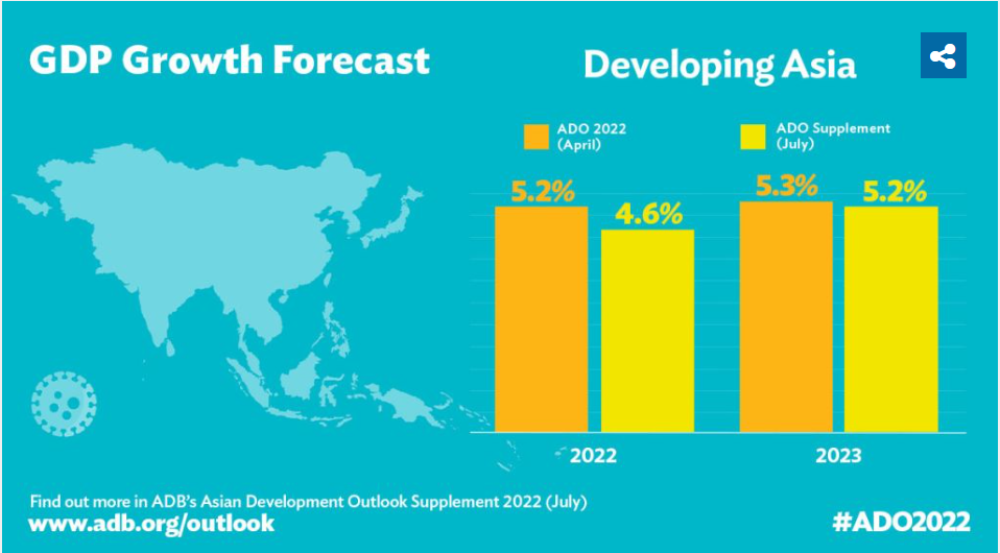
The Asian Development Bank (ADB) lowered its economic growth forecast for developing Asia and the Pacific to 4.6% this year due to slower expansion in China, more aggressive monetary tightening in advanced economies, and fallout from the continued Russian invasion of Ukraine.
The outlook compares with a projection of 5.2% issued by ADB in April. The bank also raised its forecast for inflation in the region, amid higher prices for food and fuel.
ADB’s Asian Development Outlook (ADO) 2022 Supplement, which was released on July 21, notes that developing Asia and the Pacific is continuing its recovery from the COVID-19 pandemic. Many countries are easing mobility restrictions, which is strengthening economic activity.
However, growth has slowed in China, the region’s largest economy, due to disruption from new COVID-19 lockdowns, as well as weaker global demand, according to the report.
China’s economy is reportedly poised to expand 4.0% this year, compared with an earlier forecast of 5.0%.
ADB also lowered its growth outlook for India to 7.2% from 7.5% amid higher-than-expected inflation and monetary tightening.
Inflation in developing Asia and the Pacific is predicted to accelerate to 4.2% this year, compared with a previous forecast of 3.7%. However, inflation pressure in the region as a whole is still lower than elsewhere in the world.
For 2023, ADB lowered its economic growth projection for the region to 5.2% from 5.3%, while raising the inflation forecast to 3.5% from 3.1%.
Meanwhile, growth forecasts for some subregions were upgraded. Thus, subregional growth projections are revised up for the Caucasus and Central Asia, from 3.6% to 3.8% for 2022 and from 4.0% to 4.1% for 2023. This mainly reflects improved outlooks for Armenia, Azerbaijan, Georgia, and Tajikistan, which have all withstood the economic fallout from the war in Ukraine better than expected. That said, growth in these economies may decelerate in the coming months amid the uncertain geopolitical environment.
Tajikistan’s economy reportedly grew by 7.5% in the first quarter on expanding investments, up 9.6%.
The growth forecasts for Kyrgyzstan, Turkmenistan, and sector channels. Despite these developments, the growth forecasts for Kazakhstan remain unchanged at 3.2% for 2022 and 3.9% for 2023.
The inflation forecasts for the Caucasus and Central Asia are raised from 8.8% to 11.3% for 2022 and from 7.1% to 8.1% for 2023.