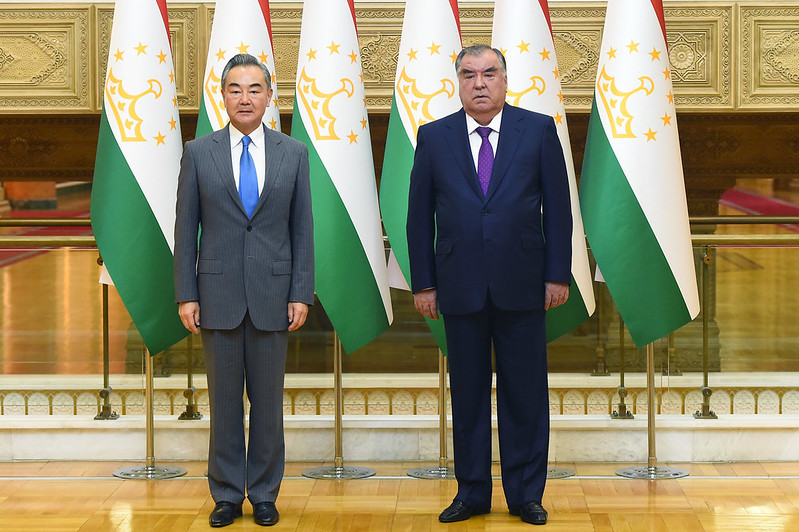
On Monday August 1, Tajik President Emomali Rahmon received China’s State Councilor and Foreign Minister of China Wang Yi, who arrived in Dushanbe on the evening of July 31 on an official visit.
The Tajik president’s official website says the parties discussed a wide range of issues related to bilateral cooperation between Tajikistan and China and cooperation between the two countries I the framework of regional and international organizations.
In the course of the talks, Rahmon reportedly emphasized a dynamic development of Tajikistan-China relations and strategic partnership between the two countries in all areas.
“Tajikistan and China are close neighbors and we are interested in further deepening of the close multifaceted ties between the two countries in all formats,” Tajik leader said.
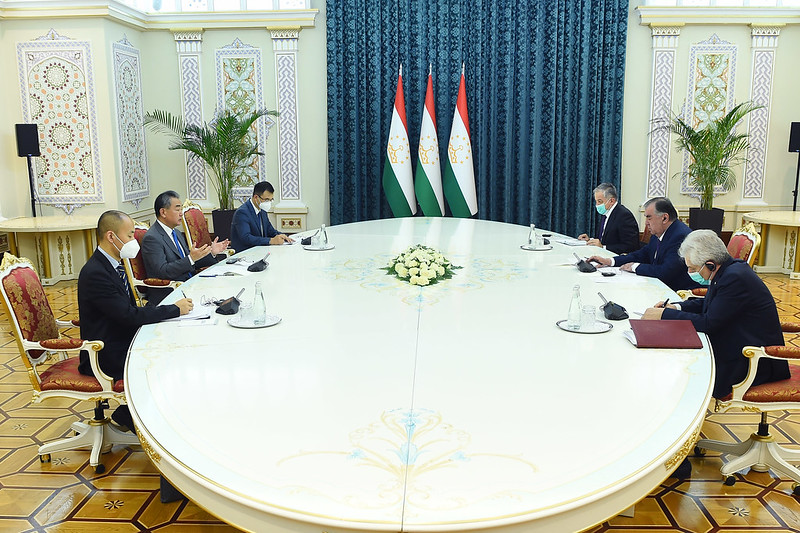
Rahmon and Wang reportedly considered it necessary to take joint steps to speed up the set pace of trade development.
The parties also discussed ways of further expansion of investment, industrial and transportation cooperation as well as development of green technologies and exports of Tajik goods, especially agricultural products, to China.
Tajik president and top Chinese diplomat also exchanged views on a number of regional and international issues being of mutual interest.
The Tajik president’s official website notes that China is one of major trading partners of Tajikistan and the largest investor in Tajikistan.
The Tajik president’s official website says that according to data of official statistics, the bilateral trade between Tajikistan and China over the first six months of this year has increased nearly 82 percent compared to the same period last and accounted for more than 19 percent of the overall foreign trade turnover of Tajikistan.
The Republic of Tajikistan and the People's Republic of China have friendly relations characterized by bilateral and multilateral collaboration.
The two countries established formal relations on January 4, 1992, shortly after the dissolution of the Soviet Union. As the leader of Tajikistan, now-President Emomali Rahmon first visited Beijing in March 1993.
Tajikistan and China are active members of regional and international organizations and as a result, they closely cooperate within the frameworks of these organizations, particularly within the framework of the Shanghai Cooperation Organization.
Because it has a border with China's Xinjiang Autonomous Region (XUAR), Tajikistan's political stability is very important to China. China firmly supports Tajikistan's efforts to preserve its national security and stability, and it also helps Tajikistan develop its economy.
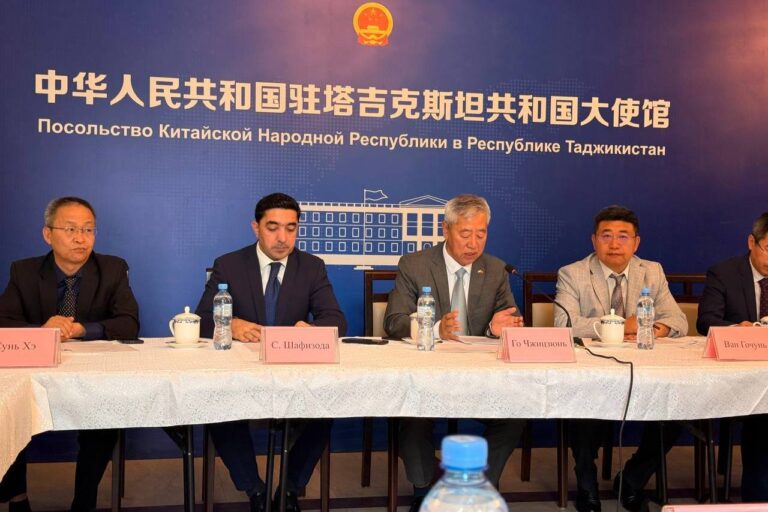
The Embassy of the People's Republic of China in Dushanbe has been functioning since March 13, 1992 and the Embassy of the Republic of Tajikistan in Beijing was established on April 7, 1997.
The legal foundation of the relationship between the two countries includes more than 200 interstate and intergovernmental agreements.