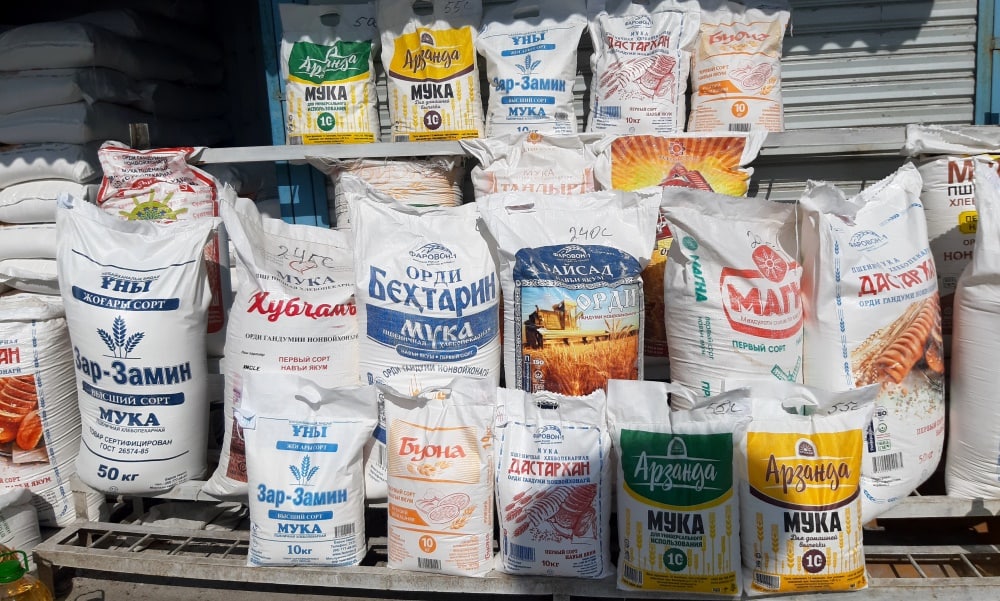
An average price for a 50-kilogram sack of the first grade flour at Tajikistan’s bazaars has fallen by 20.00 somonis.
Thus, current average price for the 50-kilogram sack of the first grade flour at Dushanbe bazaars is 360.00 somonis (20-somoni decrease compared to late July).
In Sughd province, current average price for the 50-kilogram sack of the first grade flour at local bazaars is 350.00 somonis.
In Khorog, the capital of the Gorno Badakhshan Autonomous Region, the price for the 50-kilogram sack of the first grade flour has remained unchanged – 400.00 somonis.
Tajik authorities claim that flour prices fell in the country due to the increase in wheat and flour stocks.
Meanwhile, residents say the flour prices mainly fell for two reasons: demand reduction and inability to store flour in warehouses due to heat.
In rural areas, the demand for flour has reportedly decreased. Villagers stockpile wheat for baking flatbreads, and to grind wheat into flour they bring it to lo local mills.
Earlier, the population complained about the high cost of wheat flour and some families have spent almost all of their monthly income on the purchase of wheat flour.
Over the first five months of this year, Tajikistan has imported about 17,000 tons of wheat flour (8.3-percent decrease compared to January-May 2021) and 330,000 of wheat (12.5-percent decrease compared to the same period last year), according to the Agency for Statistics under the President of Tajikistan.
Over the reporting period, the price for imported flour has risen 14.6 percent and the price for wheat has risen 10.8 percent.
A total cost of the imported flour was about 5 million U.S. dollars and a total cost of the imported wheat was 102 million U.S. dollars.
Over the same five-month period, the share of flour and wheat in Tajikistan’s imports amounted to 5.7 percent.
Meanwhile, the price for the imported first grade flour at Dushanbe’s bazaars has risen 35.7 percent over the reporting period.
The price for a 50 kilogram sack of the imported first grade flour increased at Dushanbe’s bazaars from 280.00 somonis in January to 380.00 somonis in May.
Kazakhstan provides the bulk of Tajikistan wheat and flour imports. Over the reporting period, Kazakhstan has reportedly accounted for more than 90 percent of Tajikistan wheat and flour.
Current Tajikistan’s annual requirements in wheat flour 1 million – 1.5 million tons.
According to the Tajik Government’s Forecast of Main Macroeconomic Indices, Tajikistan plans to increase wheat imports by 21.4 percent and wheat production by 12 percent within the next three years.
According to data from the Ministry of Agriculture (MoA), Tajik farmers last year produced 1.577 million tons of cereals, and they plan to produce 1.594 million tons of cereals, including 917,000 tons of wheat, this year.