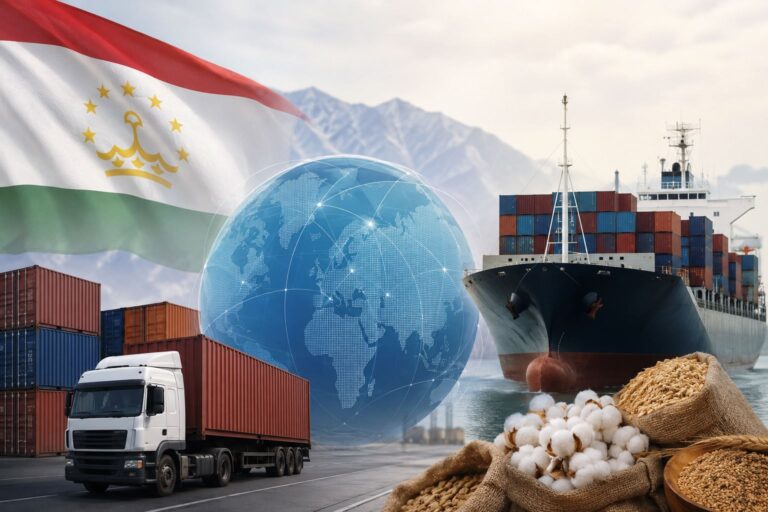
The Eurasian Economic Union (EAEU) and Shanghai Cooperation Organization (SCO) have approved 8 transport corridors.
Mikhail Myasnikovich, Chairman of the Board of the Eurasian Economic Commission (EAEC) on October 2 said in an interview with Glavny Efir (Main Broadcast) of Belarusian TV Channel Belarus 1 that they have carried out studies to develop cooperation between EAEU and SCO member nations, especially in the transport and logistics sector, and stated that it would be appropriate for the EAEU member nations to include other friendly countries in the upcoming customs clearance agreement.
“We signed cooperation documents with the SCO Secretariat. And we see great prospects. Now I will not say how strong joint projects we have seen. I will say one thing: a translogistic megaproject,” said Myasnikovich. “The lands are huge transitional opportunities that must be exploited.”
He noted that this project has several components. “We have already approved eight transport corridors linked to the international North-South and West-East corridors and aligned with the One Belt, One Road initiative,” EAEC Board Chairman said.
He called the digitization of these corridors the second component of work within the framework of a large-scale transport project. Myasnikovich explained that the implementation of the task will allow carriers to receive operational information about the load, road conditions, location of gas stations and recreation points, as well as quick data on possible emergencies.
“The third component is the agreement we have prepared on customs clearance. I have suggested to my colleagues, they agree that this agreement should be “five plus”, not just for five nations, so that the third countries could join this agreement,” Myasnikovich said.
He also stated that the EAEU has reserves to minimize the impact of Western sanctions.
The Eurasian Economic Union (EAEU) is an economic union of states located primarily in northern Eurasia. A treaty aiming for the establishment of the EAEU was signed on May 29, 2014 by the leaders of Belarus, Kazakhstan and Russia, and came into force on January 1, 2015. Treaties aiming for Armenia's and Kyrgyzstan's accession to the Eurasian Economic Union were signed on October 9 and December 23, 2014, respectively. Armenia's accession treaty came into force on January 2, 2015. Kyrgyzstan's accession treaty came into effect on August 6, 2015.
The Eurasian Economic Union has an integrated single market of 183 million people and a gross domestic product of over 4 trillion U.S. dollars. The EEU introduces the free movement of goods, capital, services and people and provides for common transport, agriculture and energy policies, with provisions for a single currency and greater integration in the future.
The Union operates through supranational and intergovernmental institutions. The Supreme Eurasian Economic Council is the “Supreme Body” of the Union, consisting of the Heads of the Member States. The other supranational institutions are the Eurasian Commission (the executive body), the Eurasian Intergovernmental Council (consisting of the Prime Ministers of member states) and the Court of the EEU (the judicial body).
The Shanghai Cooperation Organization currently has eight full members — China, Kyrgyzstan, Pakistan, Russia, Tajikistan, India, Kazakhstan and Uzbekistan.
The Islamic Republic of Iran and Belarus are acceding members.
Iran has been an observer state since 2005. On September 17, 2021, the SCO launched the procedures of Iran's accession to the SCO, which are expected to take "a fair amount of time." On September 15 this year, Iran signed a memorandum of obligations to join the SCO at the 2022 summit, and will join the organization subject to its parliament ratifying a number of agreements.
Belarus applied for partner status in the Organization in 2008. It was granted the dialogue partner status at the 2009 SCO Summit in Yekaterinburg. Belarus officially received the partner status on April 28, 2009. After applying in 2012 for the observer status, Belarus received it in 2015. On June 14 this year, Russia's Special Presidential Representative on SCO Affairs Bakhtiyor Khakimov confirmed that Belarus had applied for membership.
In addition to Iran and Belarus, Afghanistan and Mongolia are currently observer states.
Afghanistan received observer status at the 2012 SCO summit in Beijing, China on June 7, 2012. No country has yet provided diplomatic recognition to the Taliban, and its representatives have not participated in SCO meetings so far. The Afghanistan head of state first attended the 2004 SCO summit as a guest attendee.
SCO’s dialogue partners include Armenia, Azerbaijan, Cambodia, Egypt, Nepal, Qatar, Saudi Arabia, Sri Lanka and Turkey.
Bahrain, Kuwait, Maldives, Myanmar and the United Arab Emirates (UAE) are upcoming dialogue partners.
ACEAN, CIS, Turkmenistan and the United Nations are guest attendances.
Initially focused on regional security, including border conflicts, terrorism and militant Islam, its activities have expanded to cover economics and trade, transport and law enforcement. Security and economic cooperation remain priorities. China and Russia are the dominant members. Russia regards Central Asia as its sphere of influence but Chinese economic sway is growing. At an informal level, the SCO is a diplomatic platform that helps address and contain potential friction.