Fertilizer plant introduced into operation in Khatlon’s Yovon district

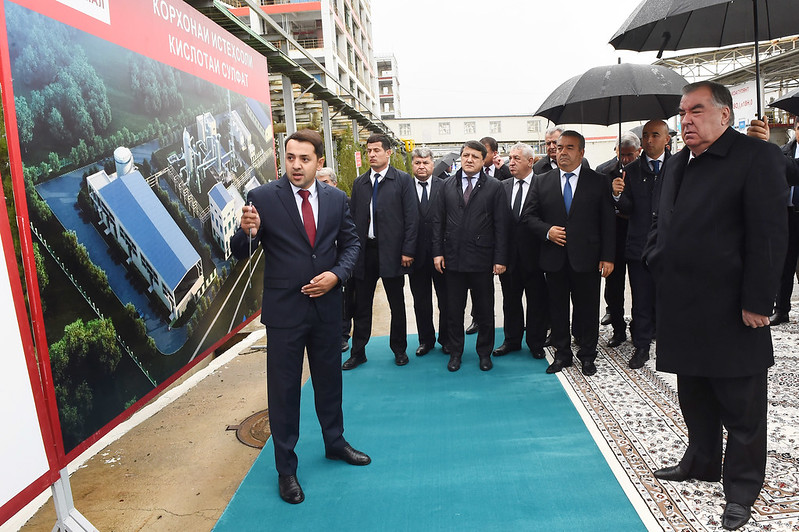
As part of his working visit to the southern Khatlon province, President Emomali Rahmon yesterday visited Yovon district, where he attended an official opening ceremony of the enterprises for the production of nitrogen and phosphate fertilizers built there by TALCO Chemical LLC, according to the Tajik president’s official website.  The production capacity of the new […]

As part of his working visit to the southern Khatlon province, President Emomali Rahmon yesterday visited Yovon district, where he attended an official opening ceremony of the enterprises for the production of nitrogen and phosphate fertilizers built there by TALCO Chemical LLC, according to the Tajik president’s official website. 

The production capacity of the new fertilizer plant is 200 tons per day and 75,000 tons per year.  

The raw material – phosphorus powder – is imported from abroad and sulfuric acid is produced at TALCO Chemical LLC itself.  In the future, raw materials will be delivered from a local mine located in Panjakent (Sughd province).  

Before this, mineral fertilizers were imported from abroad and were very expensive.   It was the high cost of fertilizers that led to a decrease in demand for them in the internal market.  

TALO Chemical LLC offers its mineral fertilizers at 2,000 tons per ton, which is which is reportedly 2.5 times cheaper than the market price.  

Meanwhile, the debt-ridden and loss-making fertilizer plant located in Levakant has not yet been reintroduced into operation. 

Khatlon governor Qurbon Hakimzoda addressing regional administrators in Bokhtar noted on January 29 this year that Open Joint-Stock Company (OJSC) Azot (formerly TojikAzot) will be reintroduced into operation this year.   

Current average price for a 50-kilogram sack of carbamide (urea) in Tajikistan is 420 somonis.  

The new owner of OJSC Azot is Osiyo Chemical Company.   

This fertilizer plant has not been in operation since 2008 due to lack of natural gas supplies.  Until 2008, when neighboring Uzbekistan upped the price of natural gas, a key input for the factory, TojikAzot served as a foreign investment-success story for Tajikistan’s economy.

According to some experts, Tajikistan’s annual requirements in mineral fertilizers are about 800,000 tons  

Join us on social media!

Article translations:

Related Article

Tenisi
Оби зулол
Оби зулол

Most Read

Коммерсбонк Точикистон

Recent Articles

RZD announces the restoration of passenger services between Moscow and Dushanbe

Direct rail services between the capitals of Russia and Tajikistan were suspended in March 2020 due to the COVID-19 pandemic.

#AP30/Stories. “Selam! Heller nichek?” How Tatars live today in Sughd province

On the 30th anniversary of "Asia-Plus," we continue to publish reports that remain relevant even after years. This story was told in 2021, and since then, little has changed in the life of the Tatar community in Tajikistan.

15,000 cameras, drones, and robots: how technology monitors pilgrims in Mecca and Medina

During Hajj 2026, Mecca and Medina were under unprecedented digital control.

Another child in Dushanbe removed from family and sent to boarding school

The Ministry of Internal Affairs reports that the parents did not pay adequate attention to the child.

Emomali Rahmon instructs to address issues in seed production following criticism of the industry

Issues have been noted with certification, seed quality, and the material and technical base of the industry.

Water, climate, and a $130 billion deficit: seven key outcomes of the Water Conference in Dushanbe

At the forum, countries and international organizations discussed new mechanisms for cooperation, investments, and technologies that are essential for addressing the global water crisis.

Eskhata Bank introduces a new generation children’s wallet

"Eshkata Bank" has created a full-fledged digital platform that helps children aged 7 to 16 learn how to manage money.