Released last month, this Migration and Development Brief (number 37 in the series) describes key developments in migration and remittance flows, and related policy and regulatory changes that have occurred since the previous brief, published in May 2022. The effects on migration and remittances of the Russia-Ukraine war, the COVID-19 pandemic, inflation, and other changes in the global economic environment are examined. According to the report, remittances to low- and middle-income countries (LMICs) increased by an estimated 5 percent in 2022, to US$626 billion. However, downside risks reportedly remain. Migration flows are rebounding from the pandemic induced decline of 2020–21. Refugee flows have also increased, especially due to the Russia-Ukraine war. In a special feature, the Brief notes that climate change will increase migration, mostly within countries. The poorest are likely to be most affected.
The report says the growth of global remittance flows is expected to be 4.9 percent in 2022. Remittance flows to developing regions were reportedly shaped by several factors in 2022. Besides the determination of migrants to help their families back home, a gradual reopening of various sectors in host countries’ economies expanded many migrants’ income and employment situation. On the other hand, rising prices adversely affected migrants’ real incomes and their remittances. In Russia, rising oil prices and continued demand for migrant workers reportedly increased the flow of remittances to Central Asian countries. The report notes that the appreciation of the Russian ruble against the US dollar translated into higher value, in US dollar terms, of outward remittances from Russia to Central Asia.
After increasing 15.7 percent in 2021, remittance flows to Europe and Central Asia are estimated to gain 10.3 percent to reach about US$72 billion in 2022. The robust performance in the year, despite Russia’s war on Ukraine, is due mainly to record-high amounts of money transfers from the Russian Federation to neighboring countries, especially to CIS members. Consequently, some CIS countries’ dependence on remittances from Russia spiked in 2022. The strong Russian ruble against local currencies, and the post-pandemic rebound in Russia’s demand for migrant workers, also contributed to the strength of remittance flows.
In 2022, remittance flows are likely to exceed, significantly, and remittance flows from Russia to its neighboring countries are likely to increase, at least for some time.
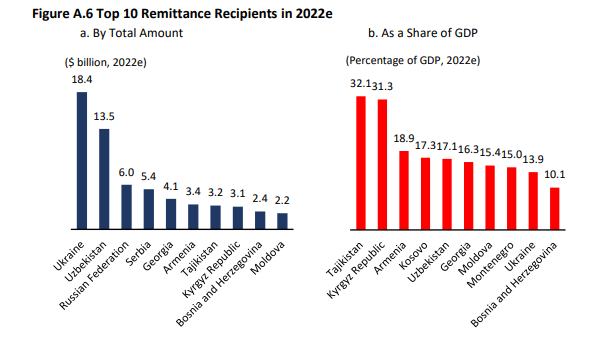
The report notes that for many Central Asian and Southern Caucasus nations within the CIS, Russia has been a major source of remittances, accounting for more-than half of total flows for Armenia, Azerbaijan, Kyrgyzstan, Tajikistan, and Uzbekistan. It was anticipated that remittances to the CIS would plummet in the wake of the Russian invasion of Ukraine. But Kyrgyzstan, Tajikistan, and Uzbekistan likely received record high amounts of remittances from Russia in 2022, as the number of migrant workers in Russia from Central Asia remained strong (in part due to a strong ruble).
As a share of GDP, remittance receipts in Tajikistan and Kyrgyzstan lead regional economies at 32 and 31 percent, respectively, as remittances remain by far the largest source of foreign currency earnings for these countries. For Uzbekistan, the most populous country in Central Asia, remittances are estimated to compose about 17 percent of GDP in 2022, up sharply from 13 percent in 2021. And in the first eight months of 2022, remittances to Uzbekistan nearly doubled to $10.6 billion from $5.7 billion in the same period of 2021—with remittances from Russia accounting for 80 percent of total inflows. The increase in part represents goods sold in Russian rubles, with the ruble thereafter sold domestically.
This year, remittances from Russia to Tajikistan are expected to amount to 3.2 billion U.S. dollars.