A meeting to discuss development of green economy in Tajikistan was held at the Ministry of Economic Development and Trade (MoEDT) on December 6, according to the MoEDT press center. Tajikistan adopted the Strategy for the Development of the Green Economy for 2023-2037 on September 30 this year.
In a report released at the meeting. Deputy Minister of Economic Development and Trade, Farhod Vosidiyon, noted that the objective of the Strategy is in carrying out institutional reforms, ensuring an efficient use of natural capital, attracting investments, introducing modern and innovative technologies, expanding international cooperation on the development of the green economy.
Concerning the issue of financing the Strategy, he reportedly noted that the amount of funding for the Strategy for the Development of the “Green Economy in Tajikistan for 2023-2037 is estimated at 21.6 billion somonis.
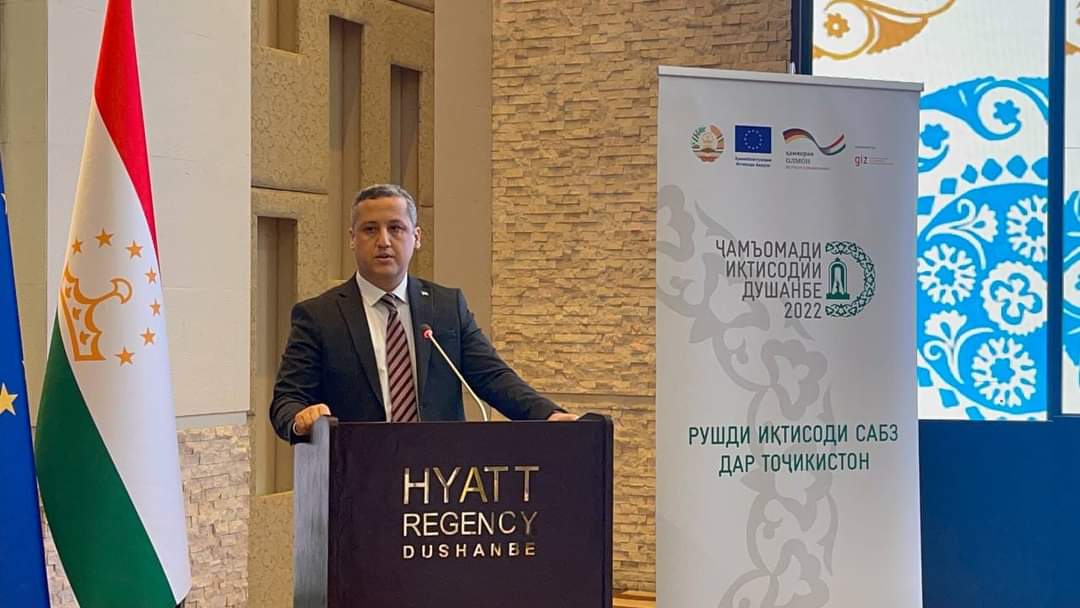
Tajik official noted that investment support of partners for development and international financial institutions plays a key role in that regard.
In this connection, partners for development have been invited to make their contribution to the timely and quality implementation of the Strategy.
Meanwhile, in order to specify the work in the direction of the green economy development the action plan for its implementation during the period of 2023-2025 as well as the strategy’s main indicators are attached to Tajikistan’s Strategy for the Development of the Green Economy for 2023-2037.
The Green aspect is part of a drive to further prioritize the greater diversity and competitiveness of Tajikistan’s economy, which also calls for wider digitalization, intensive industrialization, application of innovative technologies and human development, and ensuring the sustainable and qualitative national economic development.
A green economy is an economy that aims at reducing environmental risks and ecological scarcities, and that aims for sustainable development without degrading the environment. It is closely related with ecological economics, but has a more politically applied focus. A feature distinguishing it from prior economic regimes is the direct valuation of natural capital and ecological services as having economic value.