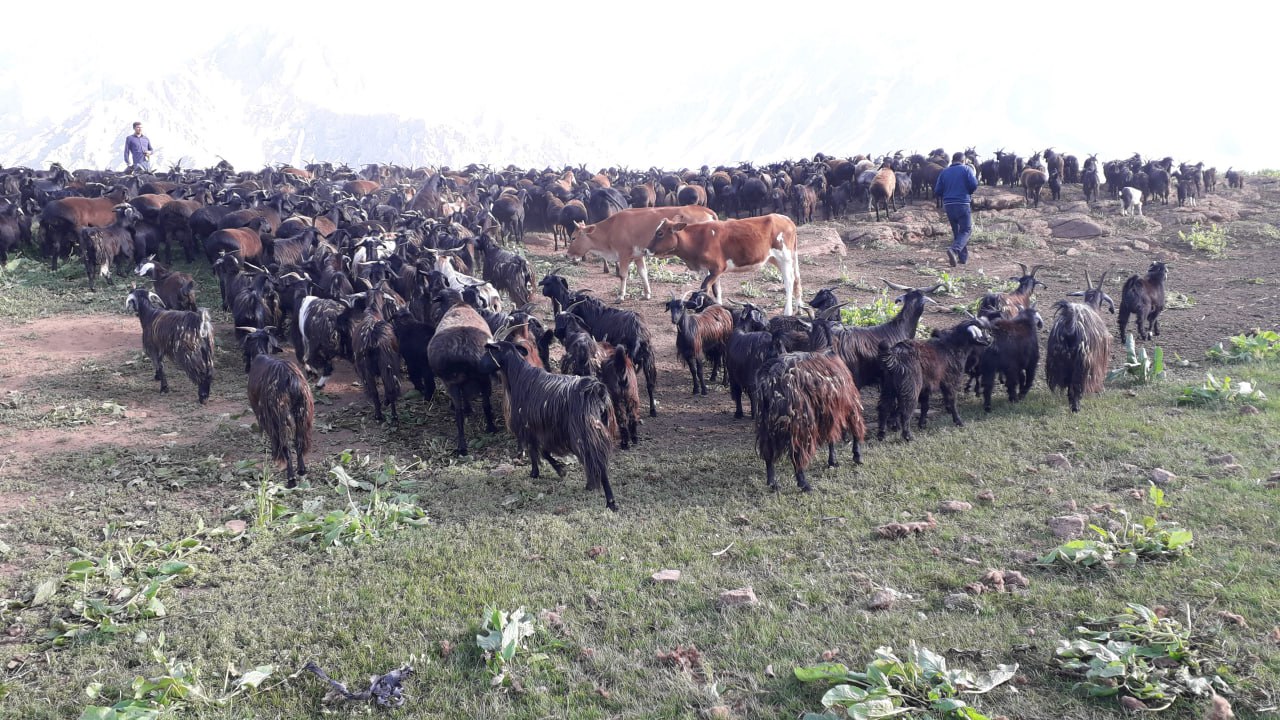
More than 28 million somonis (TJS) will be allocated for implementation of the pasture development program in Tajikistan. Of this amount, 3.245 million somonis will be allocated from the country’s budget. Besides, 24,791,800 somonis are expected to be provided for the implementation of the program from the World Bank-sponsored Tajikistan Resilient Landscape Restoration Project.
Recall, the pasture development program designed for 2023-2027 was adopted at a government session that was held by President Emomali Rahmon on November 29, 2022.
Speaking at the session, Rahmon emphasized the importance of development pastures as animal husbandry is an important industry for the development of the country.
The funds are channeled to improving pasture conditions, repairing roads and building stock driving bridges, building and repairing animal disinfection facilities, carrying out geobotanical surveys of pastures, delivering and producing pasture seeds, acquiring vehicles and other necessary equipment.
A total area of pasture in Tajikistan is 3.83 million hectares, which is 83 percent of all agricultural lands in the country.
Given that the pasture development program is designed for years, on average there are 5.6 million somonis per each year. That is about 7.40 somonis are projected for restoration of 1 ha of pasture.
The program notes that pastures are the main source of providing feed for meat breeds of cattle, yaks, sheep and goats, and horses and meet more than 60%-70% of their annual requirements in feed.
Of a total area of pastures in Tajikistan, on 284,853 hectares or 7.5 percent are year-round pastures, while the rest of the area is used for seasonal grazing.
According to official statistical data, as of November 1, 2022, there were 2,507,000 of head of cattle on all categories of farms, including 1,301,000 head of cows, 6,262,000 head of sheep and goats, and 85,000 head of horses.
Compared to 1991, the number of cattle has increased by 53 percent, the number of horses by 49 percent, and the number of sheep and goats by 50 percent.
According to accepted standards, the required area of natural pastures without irrigation is 0.5-0.7 ha for cattle; 0.25-0.3 ha for horses; and 0.07-0.08 ha for sheep and goats.
Under present conditions, grass productivity of spring, autumn and winter pastures has declined and amounts to only 150-200 kilograms.
Due to lack of pasture grasses in winter period, sheep and goats lose from 10%-15% to 25% of live weight. If we improve the condition of pastures and increase their productivity, we can increase the rate of grazing 2-3 times.
Animal husbandry ranks second after crop production in terms of total agricultural production. Availability of pasture lands and their rational use occupy a central place in providing the population with meat and milk. To-date, Tajikistan has met about 60%-70% of the annual requirements of population in meat and 80% of the population annual requirements in milk.
Last year, Tajikistan spent more than 40 million U.S. dollars for import of meat and dairy products, which is 15 times more than it is projected for implementation of the five-year pasture development program.