Tajikistan’s share in the Eurasian Development Bank has increased as part of the Russian-owned package of shares has been evenly distributed among other member nations of the Bank.
Press release issued by the EDB says the EDB Board unanimously approved a redistribution of the Bank’s charter capital among its member nations.
In accordance with the EDB’s Charter, Board members have obtained necessary authorizations and/or governmental resolutions to vote on this matter.
A portion comprising 321,151 shares held by the Russian Federation in the Bank’s paid-in capital has been evenly distributed among the other member states and, as a result, the Russian Federation’s stake in the EDB has decreased from 65.9761% to 44.7878%.
After redistribution, the other EDB member states will have the following shares in its capital: the Republic of Kazakhstan — 37.2865%; the Republic of Armenia — 4.2291%; the Kyrgyz Republic — 4.2291%; the Republic of Belarus — 5.2121%, and the Republic of Tajikistan — 4.2555%.
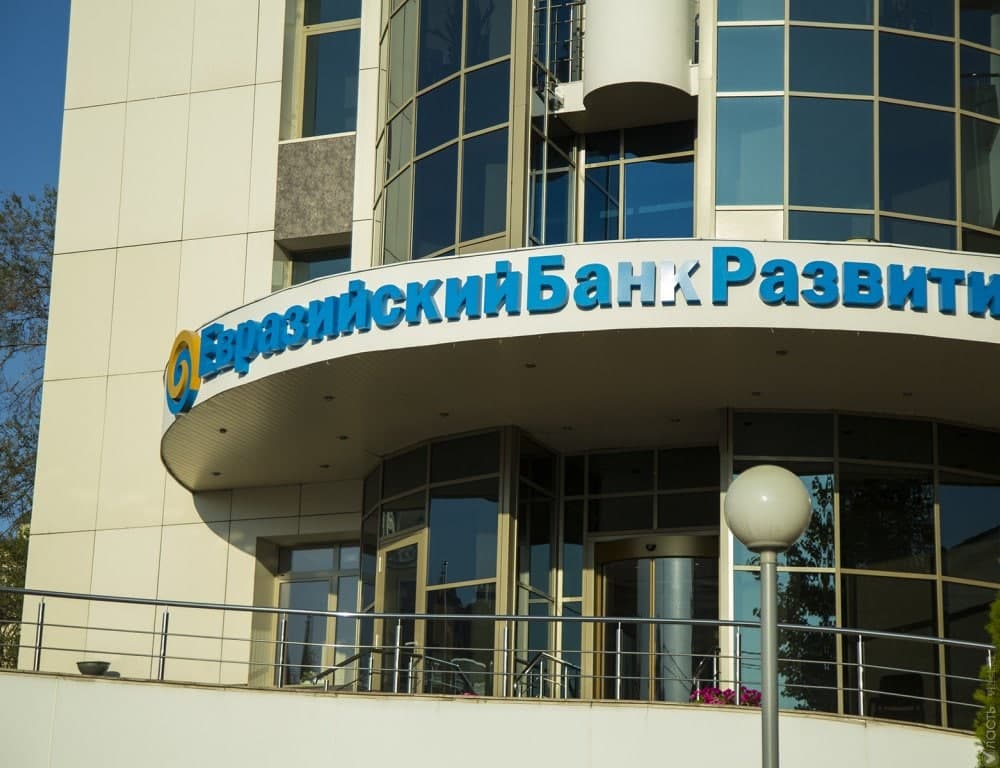
The Eurasian Development Bank is an international financial institution investing in the development of the economies, trade and other economic ties, and integration in Eurasian countries. The EDB was founded in 2006 and is headquartered in Almaty, Kazakhstan. The Bank has a branch in St. Petersburg and representative offices in Astana, Bishkek, Dushanbe, Yerevan, Minsk, and Moscow.
For more than sixteen years, the Bank has worked to strengthen and expand economic ties and foster comprehensive development in its member nations – Armenia, Belarus, Kazakhstan, Kyrgyzstan, Russia, and Tajikistan. The EDB's current charter capital totals US$7 billion. Its portfolio mainly consists of projects with an integration effect in transport infrastructure, digital systems, green energy, agriculture, manufacturing, and mechanical engineering.
The Bank’s operations are guided by the UN Sustainable Development Goals and Environmental, Social and Governance (ESG) principles.
The EDB cooperates with other international organizations, national and international development institutions, academic and civil society organizations, associations and unions to support the Bank's activities in the member states and beyond.
The EDB has held observer statuses at: the United Nations General Assembly (since 2007); the Eurasian Group on Combating Money Laundering and Financing of Terrorism (EAG) (since 2008); the UNCTAD Trade and Development Board; and the International Investment Bank (since 2014).
The EDB: is a member of the Kazakhstan Stock Exchange (KASE), the International Capital Market Association (ICMA), and the International Swaps and Derivatives Association (ISDA); participates in the Multilateral Financial Institutions’ Working Group on Environmental and Social Standards (since 2012); cooperates with the World Economic Forum (WEF; since 2014).