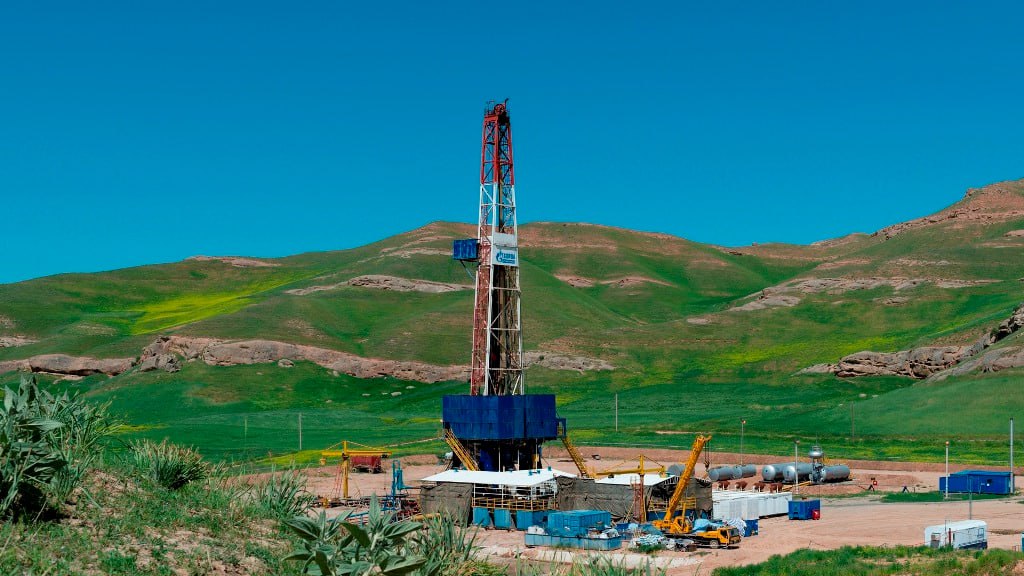
A report by the Asian Development Bank (ADB) says Tajikistan’s fossil fuel production has historically focused on coal, with oil and gas having been exploited to a lesser extent.
CAREC Energy Outlook 2030, which comprehensively analyzes options for future energy market development in CAREC countries and is one of the flagship projects under the CAREC Energy Strategy 2030, in particular, notes that Tajikistan’s domestic oil and natural gas production numbers are nearly negligible.
Annual production reportedly reaches less than 17 tons of oil and less than 1 billion cubic meters of natural gas, according to the report. About 25,000 tons of oil were reportedly produced in Tajikistan in 2022.
However, the government plans to modernize and conduct a technical re-equipment of its upstream infrastructure, as well as develop new oil and natural gas fields. The report says Tajikistan also has two operational refineries, with a cumulative capacity of 150,000 tons annually.
According to data from the Agency for Statistics under the President of Tajikistan, only 510 tons of gasoline, 4,000 tons of diesel fuel, 5,100 tons of fuel oil, and 3,200 tons of bitumen produced from domestic oil last year.
It is to be noted that since the early 2000s, the Closed Joint-Stock Company (CJSC) Hasan & Co has been engaged in oil refining in small volumes at mini refinery in Baljuvon district, Khatlon province.
In 2013, this company jointly with Iranian investors began constructing a refinery with annual capacity of 85,000 tons not far from Dushanbe, in Roudaki district. The refinery was introduced into operation in 2016.
In June 2019, Hasan & Co began constructing another oil refinery in Roudaki district. The estimated budget for construction of this refinery with annual capacity of 27,000 tons is 17 million U.S. dollars and Hasan & Co expressed readiness to invest 7 million U.S. dollars in the construction of this oil refinery.
Meanwhile, China’s Dong Ying Heli Investment and Development Co. Ltd (Heli) reportedly implemented a crude oil refinery project in Danghara Free Economic Zone (FEZ Danghara). The project involved the construction of distillation units, catalytic reformer units, storage units, and the installation of filters, pumps, gas compressors, and the laying of oil pipelines. The project was implemented in two stages: the first phase involved the construction of a refinery with the production capacity 500,000 tons of crude oil per year; and the second stage involved the construction of a facility to reach the production capacity to 1.2 million tons of crude oil per year.
However, the refinery in FEZ Danghara is not in operation yet due to lack of crude oil at affordable prices.