Tajik foreign minister meets with his Uzbek counterpart in Samarkand to discuss cooperation

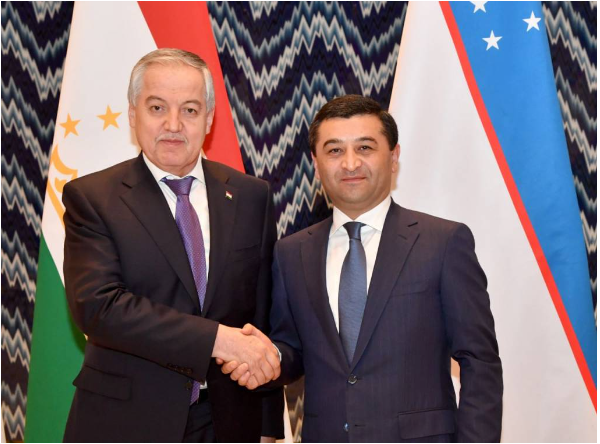
On Friday, April 14, Tajik Foreign minister Sirojiddin Muhriddin met in the Uzbek city of Samarkand with his Uzbek counterpart Bakhtiyor Saidov on the margins of the CIS foreign ministers’ meeting. According to the Uzbek MFA press service, the two exchanged views on various aspects of the Uzbekistan – Tajikistan relations of strategic partnership and […]

On Friday, April 14, Tajik Foreign minister Sirojiddin Muhriddin met in the Uzbek city of Samarkand with his Uzbek counterpart Bakhtiyor Saidov on the margins of the CIS foreign ministers’ meeting.

According to the Uzbek MFA press service, the two exchanged views on various aspects of the Uzbekistan – Tajikistan relations of strategic partnership and good-neighborliness, which has risen to a qualitatively new level in recent years.

Tajikistan and Uzbekistan have accumulated many problems after collapse of the Soviet Union.  These problems caused the countries' relations to go into a deep freeze two decades ago, including disputes over water and borders.  The two countries had had the worst bilateral relations in Central Asia.

Relations between the countries have become warmer after Shavkat Mirziyoyev came to power in Uzbekistan in 2016.  Mirziyoyev has said that improving ties with Central Asian nations is a major priority of Uzbekistan’s foreign policy.

Emomali Rahmon and Shavkat Mirziyoyev have met several times since September 2016 and in March 2018, Mirziyoyev made an historic visit to Dushanbe, where 27 bilateral agreements were signed in the fields of trade, economy, investment, finance, transport and transit, agriculture, water and energy, taxes, customs, tourism, education and science, health, culture, interregional cooperation, in the field of security and countering crime. 

Earlier in April 2018, Uzbekistan's national airline resumed flights from Tashkent to Dushanbe after a hiatus of some 25 years.  The air communication between Dushanbe and Tashkent was cut off in 1992 at Tashkent’s initiative and the issue of resumption of the direct air communication between the two countries has been raised at meetings between state officials of the two countries more than once.

27 bilateral governmental agreements addressing bilateral cooperation between Tajikistan and Uzbekistan in industry, education, border security, agriculture and much else were signed during President’s Rahmon’s state visit to Uzbekistan in August 2018. 

Join us on social media!

Article translations:

Related Article

Оби зулол
Tenisi
Оби зулол

Most Read

Коммерсбонк Точикистон

Recent Articles

RZD announces the restoration of passenger services between Moscow and Dushanbe

Direct rail services between the capitals of Russia and Tajikistan were suspended in March 2020 due to the COVID-19 pandemic.

#AP30/Stories. “Selam! Heller nichek?” How Tatars live today in Sughd province

On the 30th anniversary of "Asia-Plus," we continue to publish reports that remain relevant even after years. This story was told in 2021, and since then, little has changed in the life of the Tatar community in Tajikistan.

15,000 cameras, drones, and robots: how technology monitors pilgrims in Mecca and Medina

During Hajj 2026, Mecca and Medina were under unprecedented digital control.

Another child in Dushanbe removed from family and sent to boarding school

The Ministry of Internal Affairs reports that the parents did not pay adequate attention to the child.

Emomali Rahmon instructs to address issues in seed production following criticism of the industry

Issues have been noted with certification, seed quality, and the material and technical base of the industry.

Water, climate, and a $130 billion deficit: seven key outcomes of the Water Conference in Dushanbe

At the forum, countries and international organizations discussed new mechanisms for cooperation, investments, and technologies that are essential for addressing the global water crisis.

Eskhata Bank introduces a new generation children’s wallet

"Eshkata Bank" has created a full-fledged digital platform that helps children aged 7 to 16 learn how to manage money.