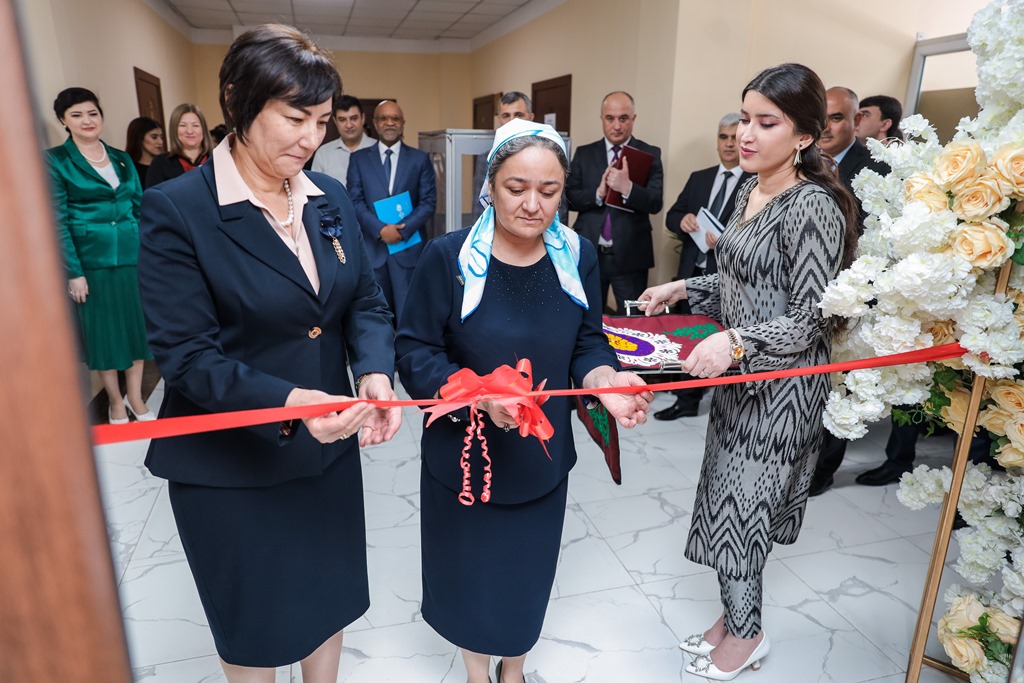
An official opening ceremony of the Child Rights Center at the Academy of Public Administration. under the President of Tajikistan took place in Dushanbe on April 26. Opened under support from UNICEF, the Center is a unique think tank on child rights specializing in collecting, creating and compiling knowledge, protocols and other training resources on child rights.
The Child Rights Center has been established with an aim to provide government officials with the knowledge and skills to address the needs of children through high-quality training programs provided by the Public Administration Academy.
The Center will further share promising practices and will help to comprehensively address the needs of every child and make decisions in their best interests.
Speaking at the Center opening ceremony, Rector of the Academy of Public Administration under the President of Tajikistan, Abdukhalil Ghafourzoda noted that children are the future of society.
“Ensuring children's rights to health protection and development of their health, physical and mental is considered the primary duty of every government servant,” Ghafourzoda said.
“UNICEF appreciates the commitment of the Academy of Public Administration to incorporate child rights in their agenda through capacity-building interventions and evidence generation. As an organization for which child rights are at the heart of everything we do, UNICEF is proud to officially inaugurate the Centre, and we are confident that this initiative will significantly impact children's lives in the future,” Mr. Osama Makkawi Khogali, UNICEF’s Representative in Tajikistan noted.
Tajikistan ratified the Convention on the Rights of the Child in 1993, pledging to the global society to uphold the rights of all children in the country and to commit to measures that ensure every child's right to a healthy upbringing, a proper education, and freedom from violence and exploitation. By ratifying the Convention, the country also pledged to enable children to have their voices heard and participate in the decisions impacting their lives in their families, communities and the society.
Since 1993, the Government of Tajikistan has achieved a significant progress towards realization of child rights since the ratification of the Convention. Some of these include the National Concept on Inclusive Education, National Strategy on Education Development 2030, National Communication Plan for ‘1000 golden days’, Law on Child Rights Protection, National Plan of Action for Elimination of the Worst Forms of Child Labor, National Plan of Action for implementation of the UNCRC Concluding Observations.
UNICEF promotes the rights and wellbeing of every child, in everything it does. Together with its partners, UNICEF works in 190 countries and territories to translate that commitment into practical action, focusing special effort on reaching the most vulnerable and excluded children, to the benefit of all children, everywhere. UNICEF operates in Tajikistan since 1993.