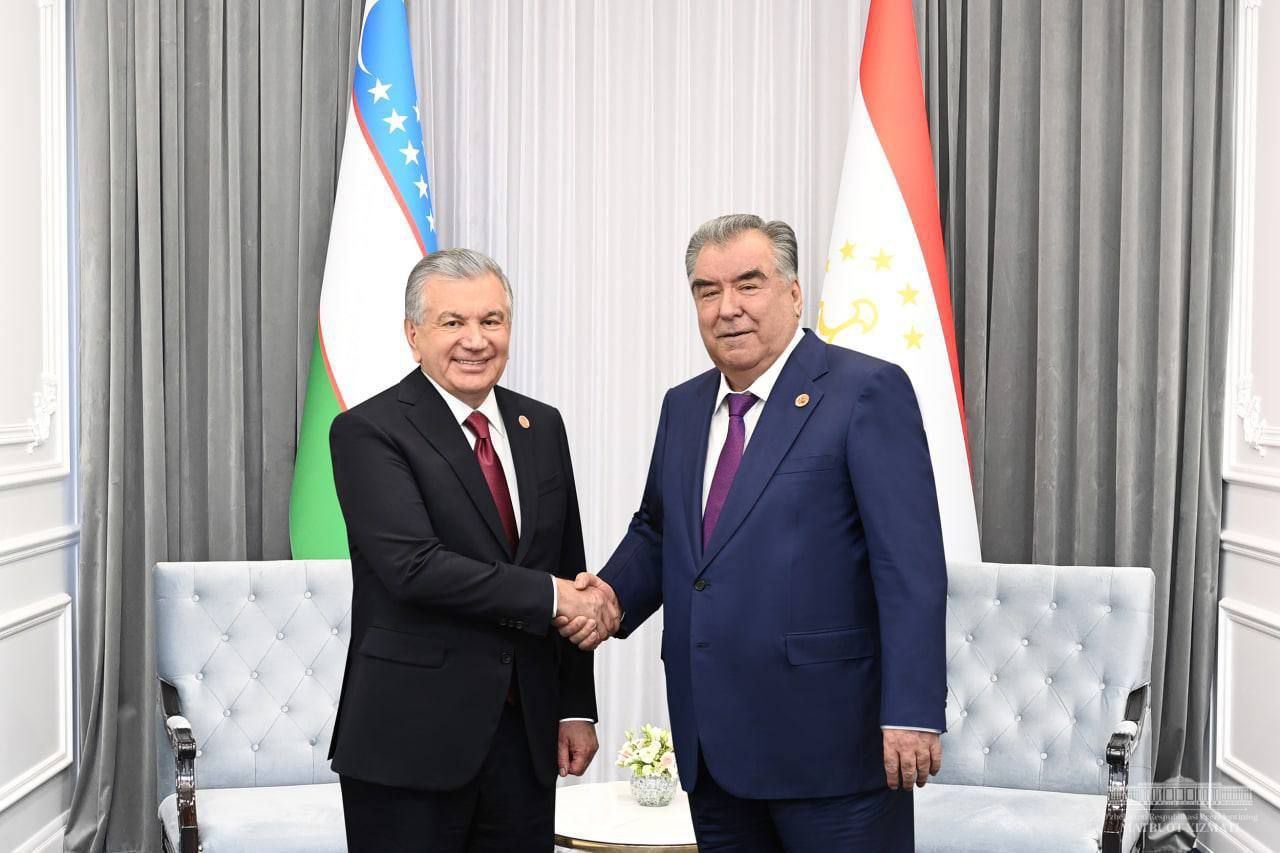
President Emomali Rahmon yesterday sent a message of congratulations to his Uzbek counterpart Shavkat Mirziyoyev on the successful holding of the national referendum, according to the Tajik president’s official website.
The message, in particular, notes that the results of the referendum once again confirm the high level of trust of the people of Uzbekistan in and their support of Mirziyoyev’s strategic course “aimed at ensuring further socioeconomic development of society and strengthening of statehood in the country.”
A constitutional referendum was held in Uzbekistan on April 30, 2023. It was to be held on proposed constitutional amendments. Parliament approved the referendum on March 15, 2023. It was accepted in the referendum with 90.21% in support.
Voters were asked whether they approved of a proposed constitutional act that would revise the current constitution.
Twenty-seven new articles were added to the Constitution, bringing a total number of articles in Uzbekistan’s Constitution to155.
Some of the suggested changes in the referendum, among others, are: extending the presidential term from 5 to 7 years; adding that Uzbekistan is a "legal, social, and secular" state (in addition to the current "sovereign" and "democratic"); introducing language discouraging the state from harming the rights and freedoms of people and citizens (including in foreign policy); adding rights/protections for the accused in crimes they have not yet been convicted of, as well as prohibiting extradition, capital punishment (constitutionally, as previously it was prohibited by presidential decree) and cruel and unusual punishment, and adding the defense of double je; adding that "Everyone has the right to protect their rights and freedoms in all ways not prohibited by law"’; adding that a person that is a member of the Oliy Majlis cannot be a member of the Supreme Council of Karakalpakstan at the same time; separating representative and executive power in regional government (previously both would be held by the regional governor).
Meanwhile, international observers say Uzbekistan’s constitutional referendum has been seen as continuation of reforms but process has been weakened by lack of genuine pluralism. Thus, observers from the OSCE Office for Democratic Institutions and Human Rights (ODIHR) said in a statement that was released yesterday that Uzbekistan’s constitutional referendum was technically well prepared and widely promoted as a move to enhance various rights and freedoms, but it took place in an environment that fell short of genuine political pluralism and competition. It reportedly lacked open debate on some contentious issues and there was no organized opposition to the amendments, and altogether, the referendum process highlighted the need to further encourage alternative political views, respect fundamental freedoms, and provide opportunities for an independent civil society to develop.