Creating a perfect jacket requires making a perfect pattern and excellent sewing skills. That was the focus of two one-week trainings in Tajikistan, where highly-qualified experts taught around 50 representatives of project partner universities and Tajik garment factories the latest techniques in patternmaking and sewing of women’s jackets, the International Trade Center (ITC) Office in Tajikistan reported on May 5.
“Garment construction is the key in fashion designing, and patternmaking and garment construction are crucial in it,” said Jahonoro Usmonova, a teacher from the Technological University of Tajikistan, co-host of the training, and a participant of this patternmaking course. “This training played an important role for us in understanding the garment from all aspects in order to perform better pattern making and sewing.”
ITC experts Irina Tannous-Filichkina, an official representative of the German patternmaking school M. Müller & Sohn in the Russian Federation and Tatiana Dumina, a technologist and an instructor of the WorldSkills Russia, led the training courses conducted at the Technological University of Tajikistan in Dushanbe and Khujand Polytechnic Institute of Tajik Technical University in Khujand.
The training reportedly covered both theory and practice in pattern drafting, garment construction, and dressmaking. The participants learned to adapt a basic pattern to fashion various types of women’s jackets.
The press release issued by the ITC Office in Tajikistan says that with hands-on activities, the participants constructed the design of jackets and learned the sewing techniques to piece them together. They also learned to take body measurements and to fit adjustments, with guidance on sewing techniques for corners, curves, lining and garment finishing.
“The knowledge gained through the training will help participants modernize the process of clothing patternmaking that can be applied to mass and individual production,” Tannous-Filichkina said.
The sessions reportedly combined hands-on activities, demonstrations and lectures. This allowed participants to develop both practical skills and creative methods for designing and sewing clothes.
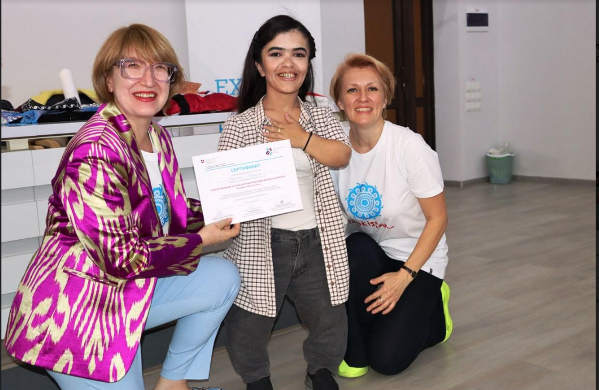
Successful participants received certificates of completion.
This tailoring-centric program was reportedly made possible thanks to the Government of Switzerland through the ITC’s Global Textiles and Clothing Program (GTEX).
The GTEX MENATEX program is funded by the State Secretariat for Economic Affairs (SECO) of the Swiss Confederation focusing on five priority countries (Egypt, Morocco, Kyrgyzstan Tajikistan and Tunisia). The program aims to encourage exports of textiles and clothing from developing countries to promote employment and income generation throughout the value chain.
Over the last 30 years, around 500 million US dollars have been allocated in the form of grants to the Government of Tajikistan and the Tajik population. Within its Cooperation program for Central Asia (2022-2025), Switzerland focuses on supporting economic, social, and democratic development, promoting an integrated and regional approach in the complex field of transboundary water management, strengthening economic ties and promoting good governance.