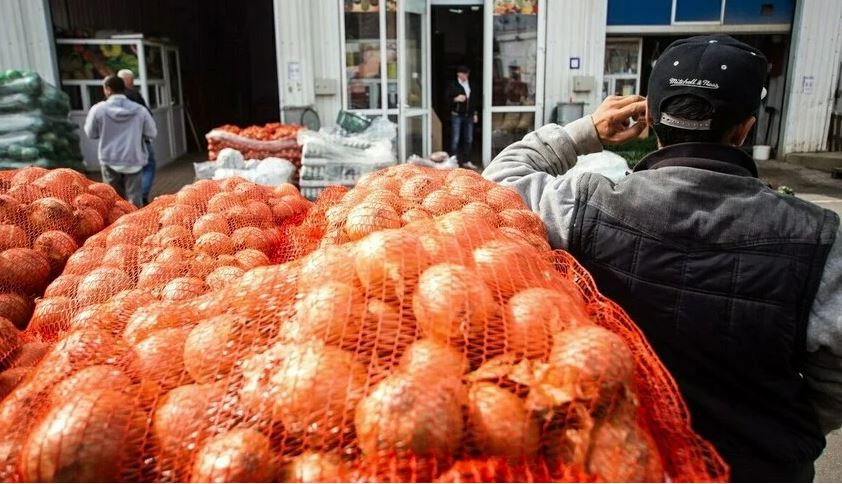
A campaign of exporting early agricultural products, including onions and various fruits, has been launched in Tajikistan. According to the Expert Development Agency under the Government of Tajikistan, about 200 tons of onions have already been delivered to Kazakhstan.
The Ministry of trade and Integration of Kazakhstan says ten regions of Kazakhstan, namely Ulytau, Kostanai, Pavlodar, Western-Kazakhstan, Eastern-Kazakhstan, Akmola, Turkestan, Abai, Zhetysou, and Zhambul region, have concluded contracts with Tajikistan on import of 260 tons of onions from Tajikistan.
Atyrau, Karaganda and Northern-Kazakhstan regions and the city of Almaty are reportedly at the stage of concluding onion import contracts with Tajikistan.
Meanwhile, Aktobe, Kyzylorda and Almaty regions have refused to buy early onions from Tajikistan.
According to data from the Ministry of Agriculture of Tajikistan, Tajik farmers this year have planted onions on a total area of more than 17,000 hectares and they are expected to produce about 700,000 tons onions this year.
Where to put so many onions, that's what farmers are thinking now. One of farming units subordinate to the city of Tursunzoda has grown a very good crop of early onions, but there is no buyer for it.
Farmers say the cost of one kilogram of the produced early onions has amounted to about 1.50 somonis this year, while buyers, including exporters, are ready to pay little more than 1.80-2.20 somonis. Local resellers are ready to pay little more – 2.50 somonis per kilogram, but they buy onions in small batches.
A net profit of farmers from each kilogram of onion grown by them is on average 0.5 somonis, while resellers earn at least 1.00 somonis from each kilogram.
“Thus, there will be little benefit from early onions,” say farmers. “In addition to onions, we have plums and watermelons, which are also exceed the needs of the local market. They also need to be exported abroad, but the prices offered by intermediary firms do not suit us.”
In recent years, the key costs of growing onions have been the purchase of mineral fertilizers and the payment for agricultural machinery and transport services.
Current Tajikistan’s annual requirements in onions are about 300,000 tons. The rest of the products will have to be immediately exported, since there are not enough storage facilities for storing agricultural products in the country.
Recall, Kazakhstan in early March signed an agreement with Tajikistan on delivering Tajik early vegetables to Kazakhstan in the off-season.
In exchange for Tajik early vegetables, Kazakhstan will export wheat and flour to Tajikistan.
This agreement was reportedly signed in Dushanbe during a working visit of Kazakhstan’s Deputy Minister of Trade and Integration, Arman Shakkaliyev, to Tajikistan.
It was noted during meeting with Tajik officials that Tajikistan has all necessary opportunities to grow organic crops, plant intensive gardens, create livestock and poultry farms.