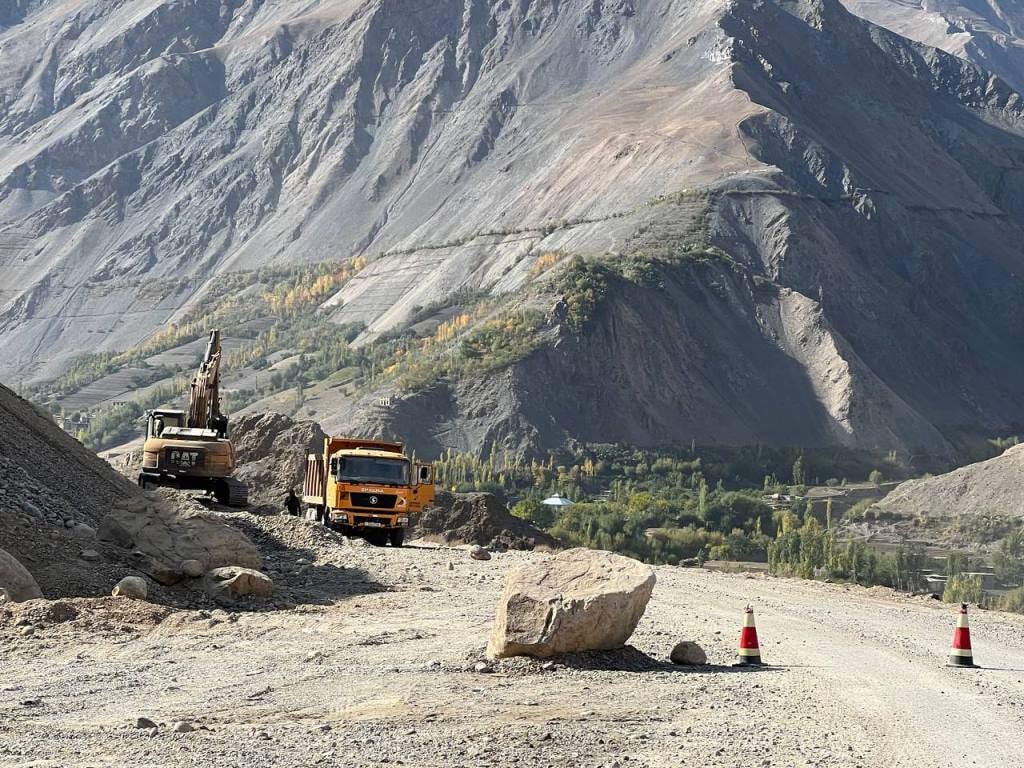
As part of his working visit to the Gorno Badakhshan Autonomous Region (GBAO), the Minister of Transport Azim Ibrohim last week got acquainted with the progress of rehabilitation of the Qalai Khumb — Vanj (up to Rushan district’s border) section of the Dushanbe-Khorog-Kulma highway, according to the Ministry of Transport (MoT) press center.
The work on rehabilitation of this section of the highway began in September last year, and over the past nine months, the most difficult stretches of this road have been leveled.
An official ceremony of the beginning of rehabilitation of the road from Qalai Khumb, the administrative center of Darvoz district in Gorno Badakhshan Autonomous Region (GBAO), to GBAO’s Vanj district (up to Rushan district) took place on June 23, 2022.
Chinese company, China Road and Bridge Corporation (CRBC), is engaged in rehabilitation of this section of the Dushanbe-Khorog-Kulma highway.
China is reportedly expected to award a US$230 million grant for rehabilitation of this 109-kilometer road, which is in a very poor state. Currently, it takes drivers up to three hours to drive this section of the Dushanbe-Khorog highway.
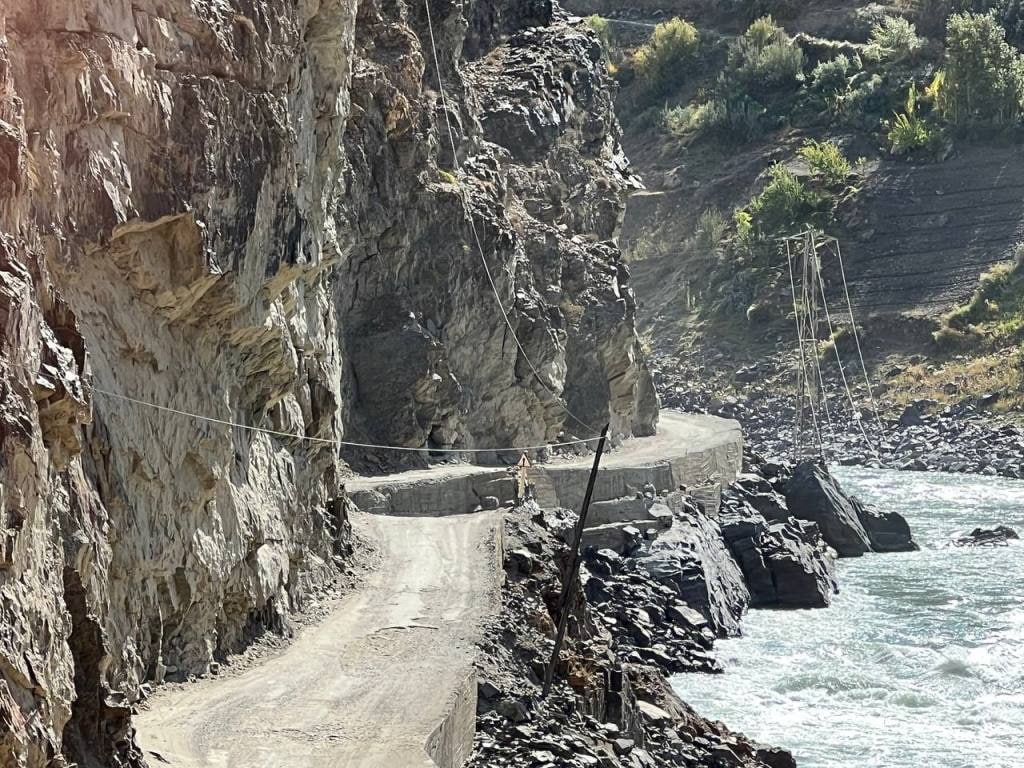
Rehabilitation of the Qalai Khumb-Vanj road includes construction of two tunnels with a total length of 5.2 kilometers, a 490-meter gallery and 15 bridges with a total length of 634 meters that will reduce the length of the road to 90 kilometers.
Rehabilitation of this section of the Dushanbe-Khorog-Kulma highway is expected to be completed by 2024.
Meanwhile, in a statement delivered at a joint meeting of both chambers of parliament, President Emomali Rahmon on December 21, 2021 noted that the Rushan-Khorog-Kulma road, which is the key section of the highway connecting Dushanbe, Khorog and Kulma Pass, will be rehabilitated within the next five years (2022-2026).
The estimated budget for rehabilitation of the 163-kilometer Rushan-Khorog section of the highway is 200 million US dollars.
567 million US dollars are needed for rehabilitation of the Khorog-Kulma section, which is 395 kilometers in length.
The Dushanbe – Khorog – Kulma Pass highway is the only overland route between Tajikistan and China.
The Dushanbe-Kulob-Khorog-Kulma-Karokurum highway may reference Asian Highway 66 (AH66) as well as parts of the famous Pamir Highway. AH66 runs from Dushanbe to Xinjiang, crossing the border at Kulma Pass and connecting to the Karakoram highway that runs north-south from China into Pakistan.
The Kulma Pass opens from the north to the southeast, and is 500 m wide from north to south and 1 km in length from east to west with a gentle incline not exceeding 20 degrees. On the Tajik side, the pass is 80 kilometers by road to Murgab. On the Chinese side, the pass is 13.9 kilometers from Qarasou, a port of entry on the Karakorum Highway, which leads to Tashkurgan (60–70 kilometers) and Kashgar (220 kilometers).
It is to be noted that the Dushanbe-Khorog highway was built in 1940 in a record three and a half months. Until 1940, it was possible to get from Khorog to Dushanbe only after driving 732 kilometers to Osh (Kyrgyzstan) by carriage road, and then 1551 kilometers by rail.