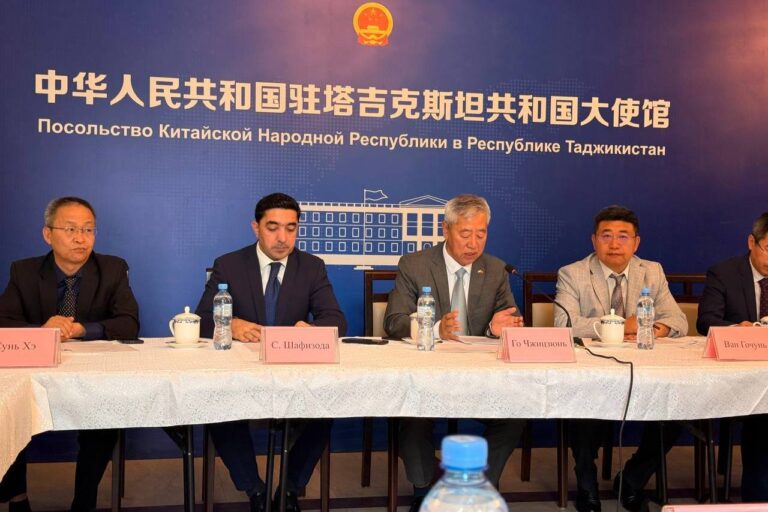
The China plus Central Asia summit that took place in Xi’an, China last month was one of the noteworthy events for Central Asia’s nations.
Tajik political scientist Parviz Mullojanov said in an interview with CABAR.asia on June 12 that the objective of the summit for China was not in solely targeting individual countries. Instead, China reportedly sought to test a new format and assume a different role in the region. The essence of this new format was that it effectively relegated other players, primarily Russia, to secondary and tertiary roles, Mullojanov noted.
“In this format, Beijing is the main guarantor of the security of Central Asia. If earlier this role was given to Russia in agreement with China, now China wants to fully assume this role,” said the expert. “In Beijing, they think that Russia should accept this as a reality, and because of the war in Ukraine, it will not oppose it.”
According to him, China has initiated discussions regarding the establishment of supranational bodies, such as a supranational business council and institutions aimed at coordinating foreign policy. This reportedly indicates China’s ambitious aspirations.
Asked about the place of Tajikistan among other Central Asian countries in China’s politics, Mullojanov noted that China does not divide like that. Instead, China views Central Asia as a cohesive community. Naturally, China places greater importance on countries that serve as sources of mineral resources, particularly oil and gas. Geopolitical significance and economic factors are also taken into account.
According to him, Tajikistan holds particular interest for China in terms of security due to its proximity to Afghanistan. “Additionally, Tajikistan is seen as a valuable transportation hub and a source of mineral and energy resources. It is important to note that Beijing regards Central Asia as a unified region rather than a collection of distinct entities,” the expert noted.
He further noted that there were no any special changes in cooperation between Tajikistan and China. At the same time, the expert highlights the strengthening of the role of China in ensuring security, military cooperation, and military technology. “For example, we are talking about Chinese drones, the supply of new equipment,” said Mullojanov. “Another trend is to provide Tajikistan with access to the so-called Middle Transport Corridor, which runs through Central Asia on to the Caspian Sea and Europe. Perhaps new trends related to issues in Afghanistan will develop.”
He added that it is worth noting that if Russia was previously considered the main partner for Tajikistan, now it is fading into the background. “Of course, Tajikistan remains a zone of influence of Russia, but now the importance of China, as well as new players, is growing,” the expert concluded.