The worsening state of the Russian economy and sustained abuse from law enforcement there is pushing ever more expatriate laborers from Tajikistan to seek out alternative countries in which to find work.
The trend stands in the long term to reduce Tajikistan’s overwhelming economic reliance on remittances flowing in from Russia. For the workers themselves, the shift presents the hope of more dignified employment and, often, much better pay.
Eurasianet reports that Azimjon Badalov, 35, traveled to the United Kingdom under a British government seasonal workers scheme designed to help understaffed farms. His job involved planting trees and picking fruit.
Badalov said he was happy with his pay, which he told Eurasianet was the equivalent of around US$12.50 an hour, and additional US$30 for every hour of overtime.
According to him, his daily earnings are about 1,000 somonis (US$91). In Russia, he reportedly used to earn that amount in a week.
Getting the job did, however, involve jumping through some bureaucratic hoops, according to Eurasianet. Initially, Badalov and his peers had to go through a series of online interviews after which they waited around one month for a British temporary work visa.
Badalov said the complications were worth it.
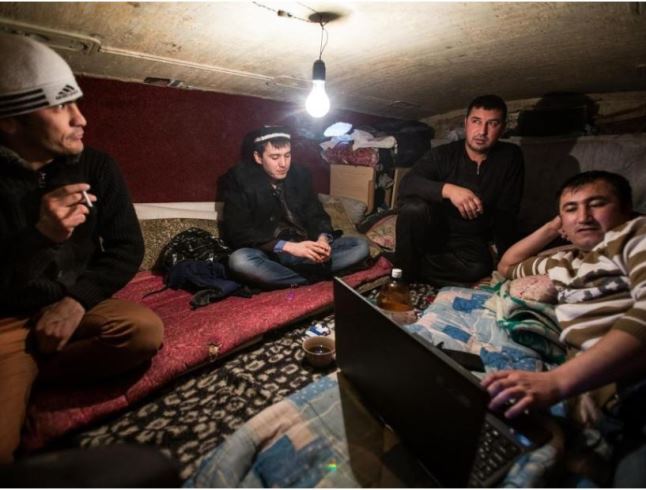
When he went to Russia, Badalov, like many of hundreds of thousands of his fellow Tajiks, reportedly worked on a construction site, where he could expect to get a US$600 monthly salary. Out of that total, US$100 was spent on Spartan accommodation, another US$50 had to be set aside to pay for the work permit, and food and other assorted expenses drained another US$150.
“In [the UK], depending on the amount of work, overtime and bonuses, we get anywhere from [US$2,700 to US$3,000]. About [US$300] goes toward rent, another [US$200] is for food,” Badalov said. According to him, that means he can cover his costs within four days, and the rest of his income can be set aside and sent home.
Badalov said that another advantage of living and working in the UK is that migrants can usually expect to face less hassle as compared to Russia.
Eurasianet notes that while the Tajik government continues to struggle to do much by way of creating employment domestically, it has been active on the diplomatic front in trying to find new destinations for its migrant workers to explore.
Dushanbe’s lobbying with South Korea has reportedly produced some returns, with small numbers of Tajik laborers traveling there for seasonal work. Talks with the United Arab Emirates and Qatar could lead to similar breakthroughs.