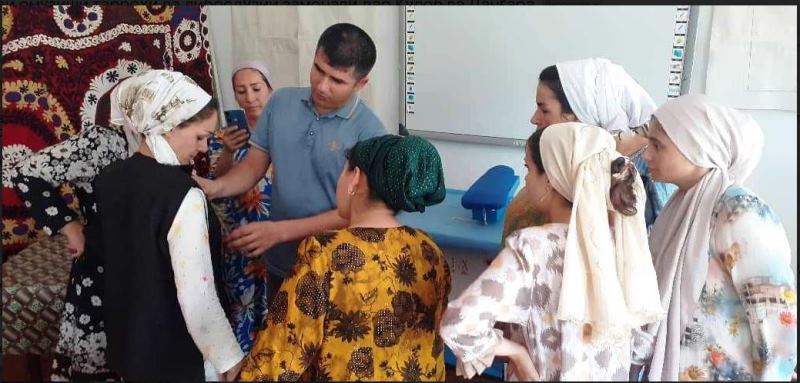
Some 25 instructors and teachers in the field of fashion and sewing from the Kulob Institute of Technology and Innovation Management (KITIM) and the Danghara State University (DSU) completed an intensive two-week tailoring course on patternmaking and sewing of women's jackets and skirts on July 28, according to the International Trade Center (ITC) Office in Tajikistan.
This tailoring-centric Training-for-Trainers (ToT) program was reportedly made possible thanks to the Government of Switzerland through the International Trade Center (ITC)’s Global Textiles and Clothing Program in close cooperation with the Kulob Institute of Technology and Innovation Management and the Danghara State University. The course was hosted by the Kulob and Danghara Garment Training Centers, launched and furnished under GTEX within these educational entities.
The training course covered practical knowledge in pattern drafting, garment construction, and sewing skills. Through hands-on experiences, the participants reportedly furthered their knowledge in drafting women's jackets and skirts on different dimensional characteristics and learned more about the sewing techniques involved in their construction.
Mr. Manouchehr Sharifov, the trainer, says: “The knowledge gained in this training will help participants to modernize the process of clothing patternmaking that can be applied to mass and individual production.”
Participants in the class were equipped with necessary skills in taking body measurements and fitting adjustments for dresses.
Mr. Saidmumin Kamolov, ITC National Program Manager, says: “This course provided a unique opportunity for participants to develop their practical skills and creative methods for designing and sewing clothes, thereby allowing for the further transfer of the knowledge and skills they gain to their students, colleagues, and employees through the Garment Training Centers”.
They also received methodological materials (workbook for the construction and technology of sewing of women's jackets and skirts for subsequent professional activities.
Successful participants received certificates of completion.
The GTEX MENATEX program is funded by the State Secretariat for Economic Affairs (SECO) of the Swiss Confederation focusing on five priority countries (Egypt, Morocco, Kyrgyzstan Tajikistan and Tunisia). The program aims to encourage exports of textiles and clothing from developing countries to promote employment and income generation throughout the value chain.
Over the last 30 years, around 500 million USD have been allocated in the form of grants to the Government of Tajikistan and the Tajik population. Within its Cooperation program for Central Asia (2022-2025), Switzerland will focus on supporting economic, social and democratic development, promoting an integrated and regional approach in the complex field of transboundary water management, strengthening economic ties and promoting good governance.