



Over the past year and a half, the number of monopolists has increased 2.5 times in Tajikistan

According to data from the Antimonopoly Agency under the Government of Tajikistan, 248 monopolistic companies have been registered today.  A monopolist refers to an individual, group, or company that dominates and controls the market for a Meanwhile, as of January 1, 2022, there were about 100 monopolistic companies operating in the country.      The Antimonopoly Agency […]

According to data from the Antimonopoly Agency under the Government of Tajikistan, 248 monopolistic companies have been registered today. 

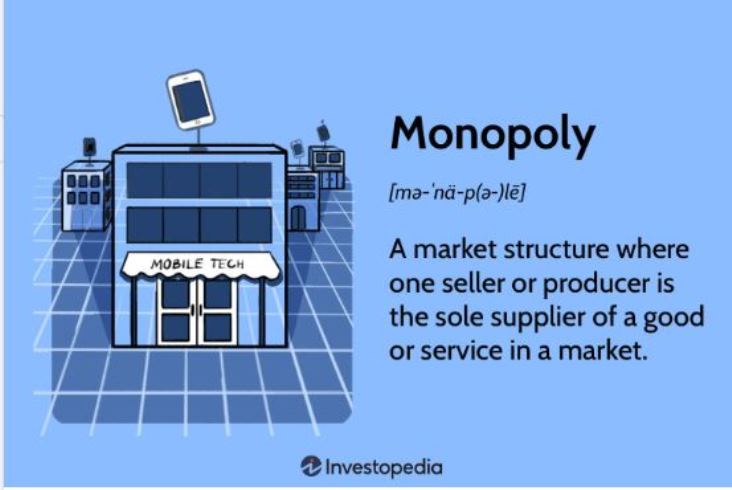
A monopolist refers to an individual, group, or company that dominates and controls the market for a Meanwhile, as of January 1, 2022, there were about 100 monopolistic companies operating in the country.     

The Antimonopoly Agency notes that the number of dominants can change at any time depending on their share in a particular market

In accordance with the country’s antimonopoly legislation, companies accounting for 35 percent of market are put on the register of dominating companies.

Three entities with a total share of not less than 50 percent and five entities with a total share of not less than 70 percent are also put on the register of dominating companies.

Before introducing new fees, such companies must coordinate them with the Antimonopoly Agency.

Current register of dominating companies includes mobile phone operators, large cement plants and many other enterprises.  

Besides, there is separate register of 30 entities of natural monopoly.  Among them are Barqi Tojik (Tajik national power utility company) and its former subdivisions, the State Unitary Enterprise (SUE) Tajik Railways (Tajik state railways company), all international airports operating in the country, SUE Khojagii Manziliyu Kommunali (KMK – the state holding company for public utilities), SUE Dushanbevodokanal (Dushanbe municipal waterworks), SUE Pochtai Tojik (Tajik Post Office), and SUE Khujandvodokanal (Khujand municipal waterworks).

Most of entities of natural monopoly are run by the government.  That is, they are either state-owned enterprises or joint-stock companies, full or controlling stake (more than 50% of the shares) of which is held by the government.

A natural monopoly is a monopoly in an industry in which high infrastructural costs and other barriers to entry relative to the size of the market give the largest supplier in an industry, often the first supplier in a market, an overwhelming advantage over potential competitors.  

Join us on social media!

Article translations:

Related Article

Оби зулол
Tenisi
Оби зулол

Most Read

Коммерсбонк Точикистон

Recent Articles

RZD announces the restoration of passenger services between Moscow and Dushanbe

Direct rail services between the capitals of Russia and Tajikistan were suspended in March 2020 due to the COVID-19 pandemic.

#AP30/Stories. “Selam! Heller nichek?” How Tatars live today in Sughd province

On the 30th anniversary of "Asia-Plus," we continue to publish reports that remain relevant even after years. This story was told in 2021, and since then, little has changed in the life of the Tatar community in Tajikistan.

15,000 cameras, drones, and robots: how technology monitors pilgrims in Mecca and Medina

During Hajj 2026, Mecca and Medina were under unprecedented digital control.

Another child in Dushanbe removed from family and sent to boarding school

The Ministry of Internal Affairs reports that the parents did not pay adequate attention to the child.

Emomali Rahmon instructs to address issues in seed production following criticism of the industry

Issues have been noted with certification, seed quality, and the material and technical base of the industry.

Water, climate, and a $130 billion deficit: seven key outcomes of the Water Conference in Dushanbe

At the forum, countries and international organizations discussed new mechanisms for cooperation, investments, and technologies that are essential for addressing the global water crisis.

Eskhata Bank introduces a new generation children’s wallet

"Eshkata Bank" has created a full-fledged digital platform that helps children aged 7 to 16 learn how to manage money.





