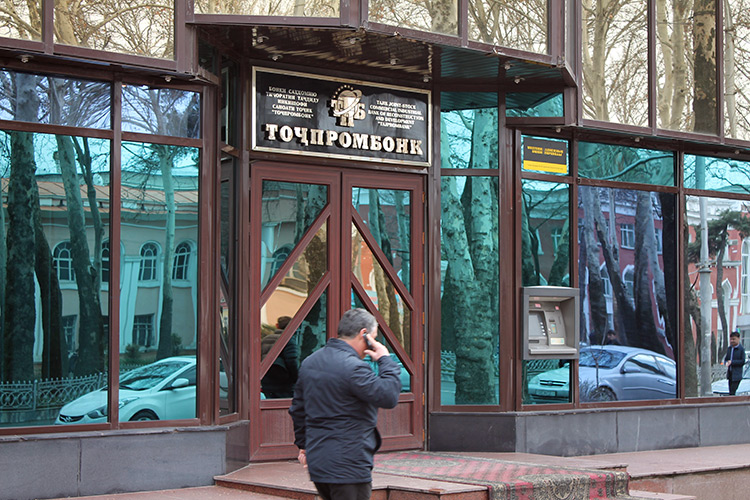
One of troubled banks that have been experiencing serious liquidity issues since 2015 — Tajprombank – has officially been declared bankrupt.
“The bankruptcy decision of this financial institution was made by the Dushanbe Economic Court on August 1, this year,” Rustam Mirzozoda, the head of the High Economic Court of Tajikistan, told reporters in Dushanbe on August 7.
The Judge at the Dushanbe Economic Court, Ms. Zulfiya Saidzoda, told reporters on Monday that Tajprombank was declared bankrupt “on the basis of the application of the National Bank of Tajikistan.”
She further noted that the bankruptcy case had been discussed for about 7 years (since March 3, 2017) and over this period, 5,726 depositors had received a total of more than 146 million somonis of their savings.
“Meanwhile, 169 people have not yet received 26.6 million somonis of their savings. Since the bank’s property and assets were in dispute, the court refrained from making a decision. Besides, Tajprombank was also unable to issue cash to depositors,” Ms. Saidzoda added.
Founded in October 1995 as an all-purpose retail bank, Tajprombank, with headquarters in Dushanbe, had 21 branches, 11 departments and 15 money-transfer offices across the country. The controlling shares of the company were held by the bank head Jamshed Ziyoyev.
Assets on Tajprombank’s books included dozens of offices and an unspecified number of residential properties.
Signs the lender was in distress began to emerge in 2015. In the middle of 2016, Ziyoyev was removed as head of the bank, which was placed under crisis administration. In December the same year, the National Bank declared it was refinancing Tajprombank to the tune of 450 million somonis and reappointed Ziyoyev to his old job and ordered him to restore the lender to health. The bailout money was raised through the emission of somoni-denominated sovereign bonds that were converted into liquid cash by the National Bank.
But then two months later, the National Bank performed yet another about-face and decided to shutter Tajprombank, together with another recipient of bailout funds, Fononbank.
Some sources say Tajprombank had over the years accumulated a number of high-stakes delinquent debtors.
One such person, Jamshed Abdulov, a businessman involved in the cotton industry, was reportedly detained by authorities over unpaid debts, according to Eurasianet. Two companies belonging to him – Cotton Textile and Olim Textile – collectively owed Tajprombank 39 million somonis. After paying off his liabilities in the form of solid assets, Abdulov was reportedly released on bail.
Sources familiar with the situation have noted that companies affiliated to Ziyoyev and his son owed US$13 million to the bank.
Tajprombank reportedly also has liabilities before the state — $13 million with the Finance Ministry and another $15 million with the National Bank. Under Tajik law, the bank is required to settle its debts to the state before it pays out retail customers.
By ruling handed down by Dushanbe Economic Court the bank liquidation process began in March 2017. Assets on Tajprombank’s books have been estimated at 450 million somonis and the total amount of the bank liabilities reportedly amounted to some 550 million somonis.
In 2019, Jamshed Ziyoyev returned 100 million somonis (equivalent to some 10 million U.S. dollars) in a form of property. This money was supposed to go to pay off debts to depositors.
In December 2020, a court in Dushanbe’s Sino district sentenced Jamshed Ziyoyev to 8½ years and six months in prison. The sentence reportedly followed his conviction on charges of embezzlement (Article 245 of Tajikistan’s Penal Code), fraud (Article 247), document forgery (Article 340) and abuse of authority by employees of commercial and other organizations (Article 295).