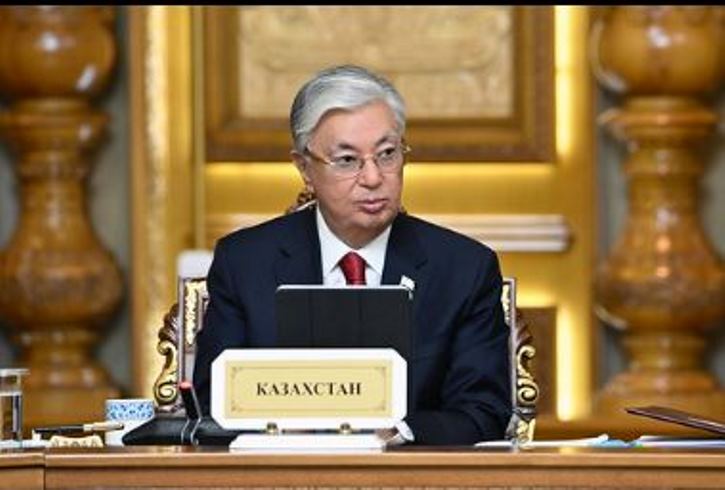
Speaking at the fifth Central Asian summit in Dushanbe, Kazakhstan’s President Kassym-Jomart Tokayev noted on September 14 that Kazakhstan remains steadfast in its commitment to strategic, multifaceted cooperation with all Central Asian countries.
He acknowledged the success of previous consultative meetings, which became an effective platform facilitated by proactive and trustworthy political dialogue that resolves any issues constructively.
According to Tokayev, intraregional trade turnover has increased by over 80% to US$10.6 billion over the past five years.
He emphasized that intensifying business contacts, multiplying joint ventures, and large regional projects bring tangible mutual benefits, reshaping the Central Asian economy.
“It is important to jointly confront contemporary threats and look for ways to address emerging problems. Most likely, the next decade will be decisive for our region, and its trajectory depends solely on how effectively we will use this historic chance,” he said.
Prioritizing to maximize economic opportunities in trade, investment, business, science, and innovation, Tokayev outlined key areas of joint work.
He, in particular, underlined the potential to increase mutual trade between the countries to US$15 billion.
Considering the significant potential of creating cluster cooperative projects for producing food, light, construction, and chemical goods, Tokayev proposed to develop an action plan for industrial cooperation among Central Asian states to form a closed production cycle for certain goods with export potential to third-country markets.
Kazakh president highlighted the major advantage of Central Asia’s location at the crossroads connecting global North and South, West and East. He noted the importance of the Trans-Caspian International Transport Route, where traffic volumes can be increased fivefold.
The president stated that Kazakhstan intends to strengthen its position as Eurasia’s transit hub, striving to accelerate large railway and road projects that will contribute to expanding economic ties with its closest partners.
Given the predictions that up to 70% of global products and services will be based on digital platforms within a decade, Tokayev stated that the unprecedented development of AI requires transforming the sphere of production, the labor market, and services.
He also called for regular dialogue between news agencies of Central Asian countries to initiate joint high-quality media projects, including a regional TV channel and news websites.
As geopolitical tensions escalate, Tokayev emphasized the need to foster stability, security, and sustainable progress in the region. He prioritized expediting the Treaty on Friendship, Good-Neighborliness, and Cooperation for the Development of Central Asia in the 21st Century, which sets out a mutually acceptable formula for achieving this shared objective.