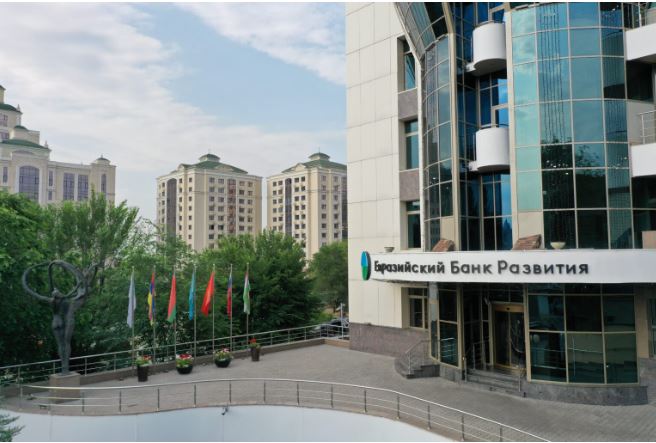
The Eurasian Development Bank (EDB), a multilateral institution in Central Asia, has unveiled its plan to issue $500 million worth of sukuk in international markets.
This was announced in a statement delivered by the EDB on the margins of the International Monetary Fund and World Bank Annual Meetings in Morocco on October 11.
Sukuk is the Arabic name for financial certificates, also commonly referred to as "sharia compliant" bonds. Sukuk are defined by the AAOIFI (Accounting and Auditing Organization for Islamic Financial Institutions) as "securities of equal denomination representing individual ownership interests in a portfolio of eligible existing or future assets." The Fiqh academy of the OIC legitimized the use of sukuk in February 1988.
The purpose of this issuance is to fund projects in the Central Asian region, with the potential to set a benchmark for other Central Asian countries.
The EDB has compiled a list of potential projects to direct this financing. Their calculations indicate that the size of Islamic financial assets in Central Asia could soar to US$10 billion by 2030-35.
In light of this, the bank has established its Islamic division and is expanding collaboration with financial institutions within the Gulf Cooperation Council. Their primary goal is to foster the development of Islamic finance in Central Asia, mainly through affiliations with organizations within the Islamic Development Bank Group.
According to the bank’s statement, the global share of Islamic finance in total assets stood at 1% in 2022 and is experiencing rapid growth. Between 2015 and 2021, the annual average growth rate of Islamic assets worldwide was an impressive 10.5%, surpassing the 5.8% growth rate observed in traditional finance assets.
The EDB member countries in Central Asia, which include Kazakhstan, Kyrgyzstan and Tajikistan, are predominantly Muslim nations. There is a growing demand for Sharia-compliant financing each year. As of the end of 2021, Islamic assets accounted for 0.2% of all banking assets in Kazakhstan, 1.5% in Kyrgyzstan.
In Tajikistan, Islamic assets accounted for 1.1% of its all banking assets as of the end of 2021.
The law on Islamic banking in Tajikistan came into force on August 5, 2014. The Open Joint-Stock Company (OJSC) Tawhidbonk is the first full-fledged Islamic bank in Tajikistan. Tawhidbonk, which had been established on the basis of OJSC Sohibkorbonk, was granted the license for banking operations in September 2019.
Kazakhstan stands out as the regional leader in Islamic finance development, largely due to its economy’s size and consistent approach to establishing the Islamic finance sector. Between 2009 and 2015, Kazakhstan adopted comprehensive legislation that regulates key areas of Islamic financial activity, including banking, the financial market, and insurance, and also issued Islamic bonds.
In contrast, the Islamic financial sector in Kyrgyzstan and Tajikistan is evolving within the context of smaller economies, which means it receives less support from the scale effect. Nevertheless, Kyrgyzstan boasts the highest share of Islamic finance in its asset structure at 1.5%, with a substantial network of financial agents operating following Sharia principles. Within this sector, there is significant potential for insurance and leasing instruments to play a crucial role in the structural landscape.
Data for Uzbekistan and Turkmenistan is not publicly available.
The Eurasian Development Bank is an international financial institution investing in Eurasia. For more than eighteen years, the Bank has worked to strengthen and expand economic ties and foster comprehensive development in its member countries – Armenia, Belarus, Kazakhstan, Kyrgyzstan, Russia, and Tajikistan. The EDB's charter capital totals US$7 billion. Its portfolio mainly consists of projects with an integration effect in transport infrastructure, digital systems, green energy, agriculture, manufacturing, and mechanical engineering. The Bank’s operations are guided by the UN Sustainable Development Goals and ESG principles. The Eurasian Development Bank has observer status in the UN General Assembly.