A 3-day International Conference and Exhibition entitled “Oil and Gas of Turkmenistan 2023” (OGT 2023) took place in Turkmenistan’s capital, Ashgabat, on October 25-27.
The conference’s agenda was reportedly focused on the future of energy, investment opportunities in the Turkmen energy sector, green and sustainable energy, technological innovations, and environmental aspects of hydrocarbon development.
OGT 2023, which is one of the largest and most successful events in Turkmenistan’s fuel and energy sector, attracted over 700 national and foreign delegates, over 400 companies, and about 10,000 visitors to the exhibition.
Tajikistan was represented at the conference by Deputy Minister of Energy and Water Resources, Ms. Sharifa Khudobakhbash.
Speaking at the conference, Ms. Khudobakhsh noted that Tajikistan’s hydrocarbon resources include 900 billion cubic meters of natural gas and 150 million tons of oil.
“These estimates had been made back in Soviet times, but we but we expect the possible gas-and-oil reserves to be much greater than currently estimated. There is a certain potential in the subsalt zone of the Tajik basin,” Tajik deputy minister said, according to Interfax-Azerbaijan.
She further noted that Tajikistan’s oil and gas industry is poorly developed today, but taking into account the existing potential, the government is establishing contacts with leading oil-and-gas companies for exploration and development of local oil and gas deposits.
The event wrapped up with an award ceremony in six categories: 1) Excellence in Energy Award: Socar, Dragon Oil, CNPC, Pel Limited, Auguste International, Çalik Enerji, Daewoo E&C Branch in Ashgabat, Baker Hughes, Yug-Neftegaz, Hyundai Engineering, Mitro International limited, Buried Hill, ENI Turkmenistan Limited, Schlumberger, NAPECO, LX International, Severtransnerud; 2) Best Moderator Award: Ambassador John McGregor, head of the OSCE Center in Ashgabat; 3) Excellence in Catering Services: Gul Zaman and Arassa Deniz; 4) Outstanding Contribution as a Knowledge Partner: Claire Godard, Head of Analytics (Middle East and Africa) at S&P Global Commodity Insights; 5: Distinguished Excellence in Technical Panel Hosting: Society of Petroleum Engineers (SPE); and 6) Exhibition Excellence Award for best booth design: Petronas (Malaysia) and Söwda Gurluşyk Maslahaty (Turkmenistan).
Currently, only two companies – domestic Somon Oil and China’s CNPC – have licenses for exploring oil and gas deposits in Tajikistan.
Somon Oil is engaged in exploring oil and gas deposits in Sughd province and China National Petroleum Company (CNPC) is engaged in exploring oil and gas deposits in the south of Tajikistan.
Ilhomjon Oimuhammadzoda, the head of the Main Geology Directorate under the Government of Tajikistan, told reporters in Dushanbe on July 27 this year that the confirmed aggregate raw-materials resources of the oil and gas bearing areas in Tajikistan amount to more than 2.5 billion tons.
Meanwhile, according to the previous expert estimates, the aggregate raw-materials resources of the oil and gas bearing areas in Tajikistan amount to about 1,000 billion tons of reference fuel. At the same time, production work at oil and gas fields require considerable expenditure, since hydrocarbon deposits occur at depths ranging from 6.5 to 8 kilometers.
According to data from Tajikistan’s Main Geology Directorate, 24 oil deposits and 14 natural-gas fields have been registered in Tajikistan so far.
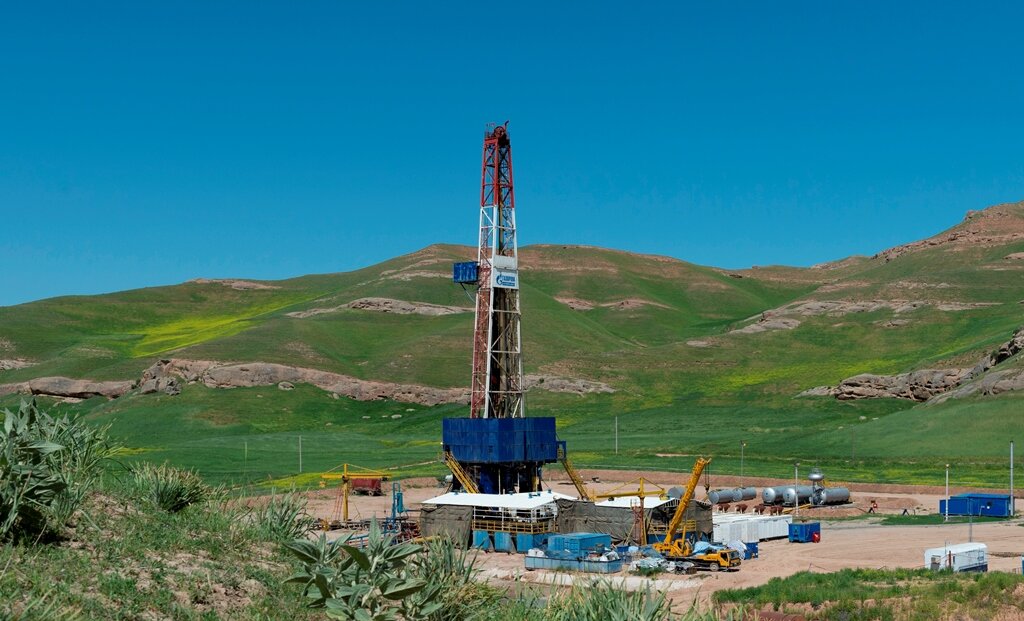
Recall, Gazprom International, an affiliate of Russia’s state-controlled company Gazprom, had licenses for exploration of four gas fields in Tajikistan.
In 2006, Gazprom received licenses from the Tajik government to explore Rengan and Sargazon oil and gas reserves. According to Gazprom, the Rengan field, located 20 kilometers from the Tajik capital, Dushanbe, has possible gas reserves of 35 billion cubic meters and the Sargazon field, located in Khatlon province 150 kilometers from Dushanbe, has possible reserves of 30 billion cubic meters.
Gazprom International gave up licenses for exploration of the Sargazon and Rengan fields in 2014.
On September 15, 2009, Gazprom received licenses for exploration of the Western Shohambari and Sariqamish fields; the licenses expired on September 18, 2018.