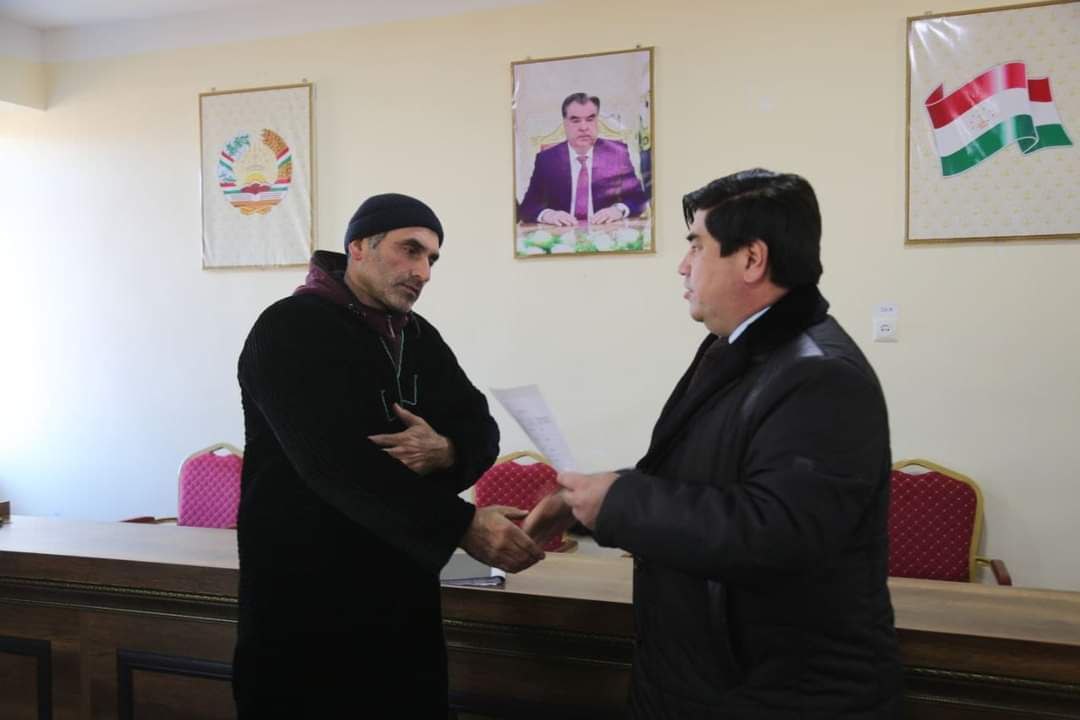
126 families from Vahdat village in Guli Surkh jamoat, which is subordinate to the city of Istaravshan in Sughd province, have finally received housing warrants.
Istaravshan Mayor Adham Mamourzoda has signed a decision that resolved the problem that had faced residents of Vahdat village for 22 years.
The Istaravshan administration press center says the mayor has met with residents of Vahdat village regarding certificates for their houses.
126 families from this village are environmental migrants from Sughd’s Ayni district, where they had lived Vashan village. They have lived in Vahdat village since 2001 but have not had certificates for their houses for22 years.
They mayor has singed the decision and they received housing warrants at the eve of New Year.
“The signed decision will become the legal basis for the privatization of the houses,” an official source within the Istaravshan administration told Asia-Plus in an interview.
Environmental migrants are people who are forced to leave their home region due to sudden or long-term changes to their local or regional environment. These changes compromise their well-being or livelihood, and include increased drought, desertification, sea level rise, and disruption of seasonal weather patterns (such as monsoons. Though there is no uniform, clear-cut definition of environmental migration, the idea is gaining attention as policy-makers and environmental and social scientists attempt to conceptualize the potential social effects of climate change and other environmental degradation, such a deforestation or overexploitation.
“Environmental migrant” and “climate migrant” (or “climate refugee”) are used somewhat interchangeably with a range of similar terms, such as ecological refugee, environmental refugee, forced environmental migrant, environmentally motivated migrant, environmentally displaced person (EDP), disaster refugee, environmental displacee, eco-refugee, ecologically displaced person, or environmental-refugee-to-be (ERTB).
According to data of the Emergencies Committee under the Government of Tajikistan, there are 381 areas in Tajikistan, which may be susceptible to natural disasters. A third of them are the so-called landslide-prone areas. The most dangerous areas are reportedly located in Rasht Valley (eastern Tajikistan) and Khatlon province (southern part of Tajikistan).