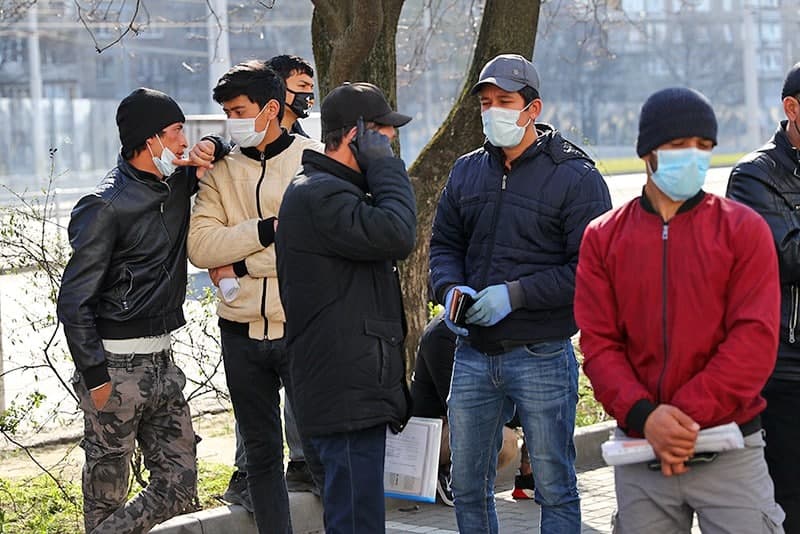
With each passing year, labor migrants from Tajikistan in Russia come up against new difficulties in securing work permits and formalizing their right to live in the country.
Eurasianet reports that at the start of 2024, the Russian representative office of Tajikistan’s Ministry of Labor, Migration and Employment of the Population (MoLMEP) issued a new warning to Tajik nationals about new tightened rules for receiving labor patents – the term for a temporary work permit.
Under the updated system, migrants in receipt of a patent are now required to inform the local branch of the Interior Ministry migration service within two months. If that condition is not met, the patent is revoked without warning and the holder is not permitted to apply for a new one for at least another year.
Since January, the cost of a patent has increased sharply, by around 13-15 percent, depending on the region. In Moscow and the Moscow oblast, the fee for the document, which has to be renewed monthly, has gone up to 7,500 Russian rubles (US$85), up from around 6,600 Russian rubles.
In some regions, local authorities have introduced restrictions on where migrants can work. In the Kemerovo, Kurgan, Magadan, and Tula oblasts, expat laborers are prohibited from working in the production of baby food and dietary food products. Other off-limits areas are public transportation, the hotel industry, education and healthcare at all levels, and beauty and massage parlors.
Where they are able to work, migrant laborers often run the risk of not getting paid.
A MoLMEP reported on January 12 that it had negotiated the payment of US$2.7 million of unpaid back wages to Tajik nationals. That is likely only a paltry proportion of the unknown overall total.
Eurasianet notes that as officials in Dushanbe freely admit, employment contracts are often nonexistent and it similarly common for workers to be hired off the books. Workers can be employed by people whose names they do not know and companies whose legal address is a mystery. The option of going through the legal system to press employers to pay back wages is usually only available when all the rules have been followed.
A more drastic solution for those seeking certainties is simply to apply for Russian citizenship. Ever more Tajiks are doing just that.
According to Eurasianet, more than 63,000 Tajik citizens received Russian citizenship in 2020. In 2021, that reportedly went up to 104,000. In 2022, it was 174,000. That record number looks to have been matched in 2023 — in the first half of the year, 87,000 Tajik nationals got Russian citizenship.
Under an agreement signed with Russia in 1997, Tajik nationals are allowed to hold dual citizenship.
Russian citizenship has come with an added element of peril since February 2022, when President Vladimir Putin embarked on a so-called “special military operation” in Ukraine. Such is the need for manpower that the Kremlin has introduced a new path of expedited citizenship.
Under a decree signed into law by Putin earlier this month, foreigners who sign a minimum one-year contract with the Russian armed forces will be eligible to apply for citizenship. Relatives of people benefitting from that fast-track system will also qualify for an expedited application process.
Many Tajiks unable to find decently paid work in their home country will likely fall to the temptation of that dangerous bait.