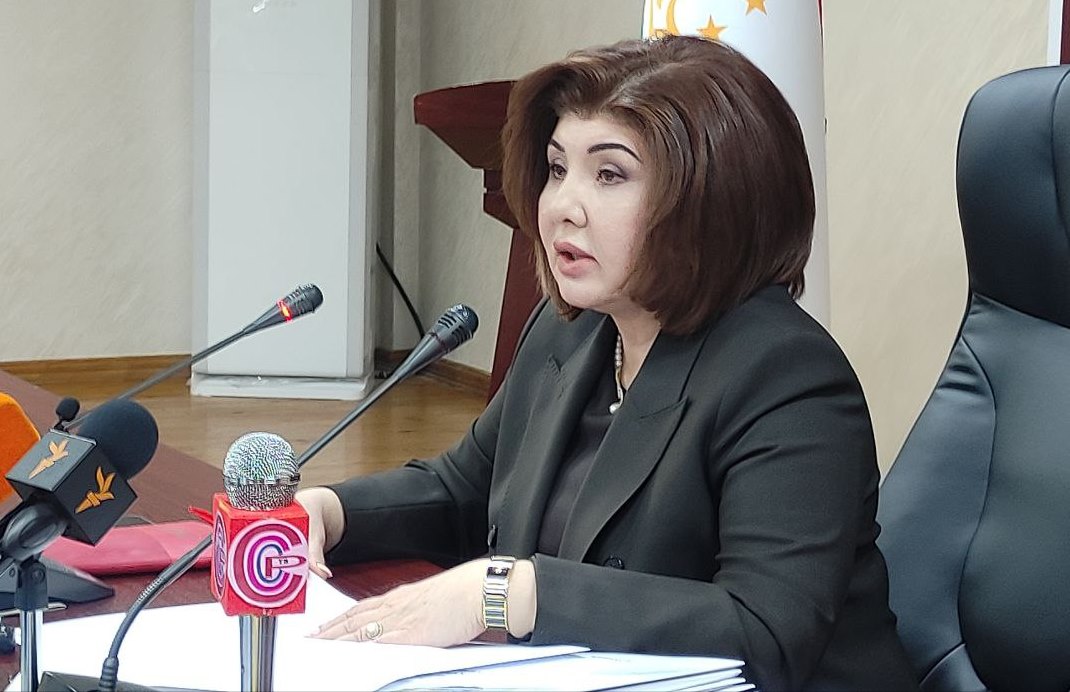
In a report released at a news conference in Dushanbe, the Minister of labor, Migration and Employment of the Population Gulnora Hasanzoda noted on February 12 that interest of Russian companies in Tajikistan’s labor resources is growing.
According to her, more than 100 companies from the Russian Federation have applied to hire more than 20,000 workers in Tajikistan.
Besides, there is a demand for Tajik workers from companies in Turkiye, Kazakhstan, Belarus, Poland, Latvia, Romania, Qatar and Saudi Arabia, the minister said.
“Of course, these companies need workers of relevant specialties for which there is demand in these countries,” Ms. Hasanzoda said.
She, in particular, spoke about the requirements for Tajik citizens wanting to work in the United Kingdom.
“Candidates must have the basic level of English proficiency and documents confirming qualification, for instance, in the agrarian sector,” said she. “Currently, preparations are underway for sending workers from Tajikistan to the United Kingdom to collect vegetables, berries and fruits in farmers' fields.”
The minister also noted that introducing the employment permit system (EPS) for working in small and medium-sized enterprises in South Korea has become an important achievement.
“We will begin to send labor resources to Sought Korea starting from 2025 after the signing of a memorandum on intergovernmental work permits and opening of local EPS center,” Ms. Hasanzoda emphasized.
She also noted that Tajikistan and Kuwait last year signed a memorandum of understanding (MoU) for labor exchange in the private sector.
Touching upon the migration situation in the country, Ms. Hasnzoda noted that the number of Tajik citizens traveling abroad last year in search for better employment opportunities decreased by 16 percent compared to 2022.
In 2023, 652,014 Tajik nationals, including 554,804 men and 97,210 women, traveled abroad seeking better employment opportunities, which is 123,564 people less than 2022 (in 2022, 775,578 Tajik labor migrants traveled abroad, primarily to Russia, but also to Kazakhstan, Uzbekistan and Kyrgyzstan ).
Of those 652,014 Tajiks, who traveled abroad last year, 627,028 traveled to Russia, 18,418 others traveled to Kazakhstan and 6,568 people traveled to other countries.