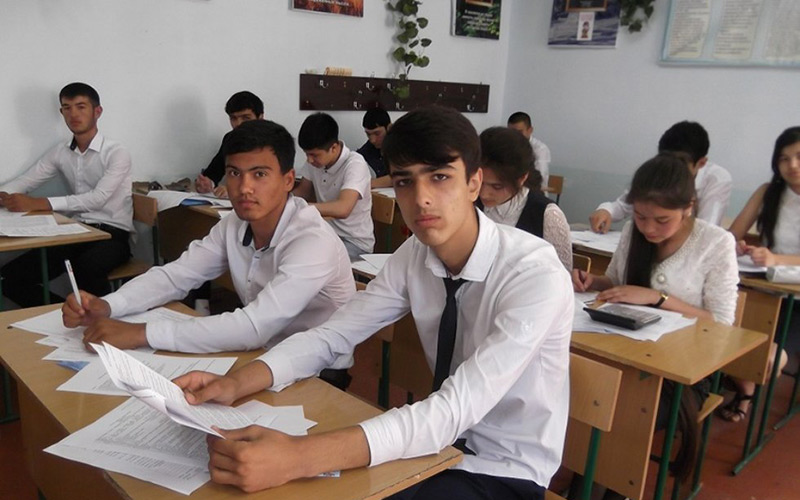
Under amendments made to the country’s law on education, attending grades 10-11 (upper secondary education) in school has become compulsory in Tajikistan. Before that education from grades 1-9 was compulsory. Now, if students do not want to continue studying in grades 10-11, they must continue studying at vocational technical schools.
Sadoi Mardum, the mouthpieces of Tajikistan’s parliament, says the draft amendments to the education law were approved by members of the Majlisi Namoyandagon (Tajikistan’s lower chamber of parliament) on February 20.
The newspaper cited the presidential adviser on legal issues Zarif Alizoda as saying that the draft law offering amendments to the country’s law on education “was developed in order to cover citizens with general secondary education.”
Presenting the bill to lawmakers, the Minister of Education and Science Rahim Saidzoda reportedly stated that “this step will make it possible to streamline the process of providing quality education for the country's citizens.”
“By this way the issue of covering 34,200 students [who completed the 9th grade – Asia-Plus] with further education will be resolved,” the minister added.
Tajikistan’s education system is structured so that the primary school cycle lasts 4 years, lower secondary lasts 5 years, and upper secondary lasts 2 years.
The country’s education system, which follows the model adopted when the country was part of the former Soviet Union, comprises: (i) preschool education; (ii) 11 years of general education, including primary (grades 1–4), lower secondary (grades 5–9), and upper secondary (grades 10–11); (iii) primary vocational education and training (PVET); (iv) secondary vocational education and training; and (v) higher education. Everyone has the right to education, and education from grades 1-9 is compulsory.
The Ministry of Education and Science (MoES) manages all levels of the education system except for PVET, which is under the Ministry of Labor, Migration and Employment (MoLME).
Compulsory education refers to a period of education that is required of all people and is imposed by the government. This education may take place at a registered school or at other places.
All countries except Bhutan, Papua New Guinea, Solomon Islands, and Vatican City have compulsory education laws.