CABAR.asia says forest lands In the Gorno-Badakhshan Autonomous Region, or GBAO, that previously were degraded are now being restored. The “bottom-up” approach that involves the active participation of local residents in decision-making on forest restoration and sustainable use reportedly played a key role in this process.
Currently, green floodplain forests stretch in the picturesque valleys of the Western Pamirs along turbulent mountain rivers at altitudes over 2,000 meters above sea level. However, this is not how it was before.
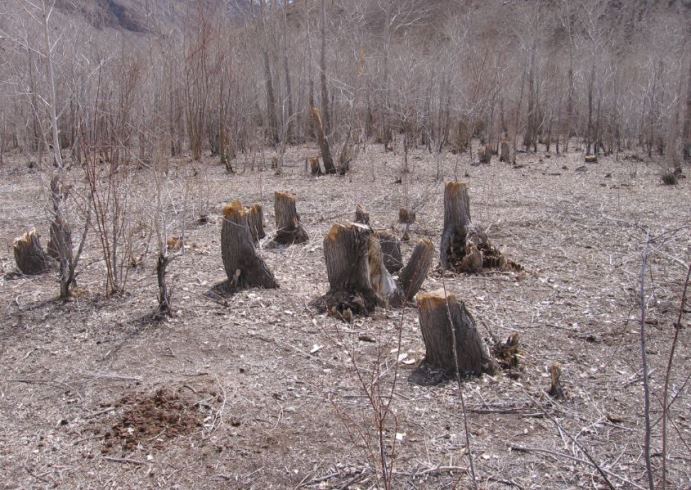
The Soviet Union collapse in 1991 and the subsequent civil war in Tajikistan (1992-1997) were challenging for GBAO. Isolation from the outside world, lack of electrical power and coal forced people to use trees for heating and cooking.
This led to catastrophic forest degradation: almost 90% of the Pamirs’ forest resources were destroyed. Sand and dust storms have become common in a number of GBAO regions. Even after the war, forest degradation reportedly continued. Open access to forest resources and weak control by the small number of forestry staff made forests extremely vulnerable.
The restoration of forest lands in Tajikistan began in Barvoz, the small high-mountain village in the Western Pamirs. Since 2009, within the framework of the “Joint Forest Management” approach, the GBAO State Forestry Agency reportedly began providing residents of Barvoz village of Roshtqala district with forest land plots for long-term use for a period of 20 years with subsequent extension.
GIZ in partnership with the State Forestry Agency provided consultations and technical support to local forest users.
The Joint Forest Management is based on a bottom-up approach, which means that the restoration and sustainable use of forest ecosystems is only possible with the active participation of local residents. Thus, former illegal forest users now legally use forest areas and are responsible for their protection and development. The collected wood is shared between the users and the Forestry Agency, which benefits both parties and encourages effective forest management.
Experts note that the forests of Tajikistan, including the forests of Western Pamirs, are not only a source of valuable resources but also a key factor in conserving water resources, protecting soil, and ensuring biodiversity.
According to them, successful forest restoration is only possible with the cooperation of all stakeholders, considering the unique nature of the area and an integrated approach that simultaneously solves environmental, economic, and social problems.
They say the Joint Forest Management leads to the restoration of key functions and ecosystems of forest lands. This contributes to adaptation to climate change, mitigation of its effects, biodiversity conservation, and resistance to desertification. It is important to note that Joint Forest Management has a significant impact on the implementation of three UN conventions: the Convention on Biological Diversity, the Framework Convention on Climate Change, and the Convention to Combat Desertification, the expert added.
The main achievements of the implementation of Joint Forest Management in GBAO are the reduction of illegal deforestation, restoration of a significant part of forests, improvement of the quality of life of local communities, and improvement in the environmental situation in the region.
The Joint Forest Management approach in the Western Pamirs has reportedly proven itself to be an effective tool for sustainable forest management and expanding its application to other regions of Tajikistan could be the key to the conservation and restoration of valuable forest ecosystems.
Today, the Joint Forest Management is implemented in four districts of the GBAO: Roshtqala; Ishkashim, Shugnan, and Vanj. Agreements on long-term use of forest land plots were signed with about 500 forest users. In total, the forest area in GBAO is over 10 thousand hectares; currently, more than 2.5 thousand hectares of forest land are being restored within the framework of the project.
With GIZ support, a reform of the forest industry was carried out at the state level to spread the Joint Forest Management approach developed and implemented in GBAO to different regions of Tajikistan. In 2011, a new Forestry Code was adopted, which provides for various forms of local residents’ participation in forest management. Today, the Joint Forest Management is implemented not only in GBAO but also in some districts of Sughd and Khatlon provinces.