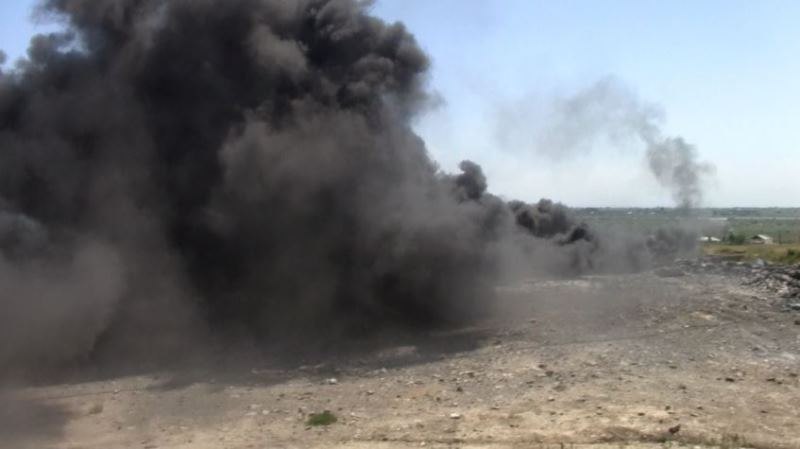
An article posted on CABAR.asia’s website says hundreds of households in southern Tajikistan suffer from black and fetid smoke from lime kilns. Environmental experts state that the harm from these emissions is evident even outside the area.
Nine lime kilns producing quicklime 24/7 are reportedly located in the Qizil Qala jamoat of Khuroson district in Khatlon province, 80 kilometers south of Dushanbe.
Quicklime for construction works is sold to different cities and regions of the country.
The waste from this hazardous industry is dumped in the nearby hills. This, according to environmental experts, is harmful to the environment.
The experts also state that the black smoke produced by burning lime is very harmful. It increases the number of diseases, especially such as hypertension and respiratory diseases.
Despite this, local residents who have suffered from the harmful smoke and dirt from lime kilns for years, do not complain about them to the authorities. Indeed, thanks to this production, dozens of nearby villages’ residents can provide for their families.
Asroriddin Tabarov, head of the Environmental Protection Department of the Khuroson district, said these lime kilns belong to two companies that received lifetime licenses.
According to him, they hold meetings and engage in dialogue with workers of this industry, warn about the dangers, and ask them to stop burning lime. However, they cannot close the production, since they work officially.
He says they visit the kilns with representatives of law enforcement agencies, explain everything, but they work officially. “Last year, they were fined more than 40,000 somonis (approximately US$3,700). They are under control,” Tabarov said.
Although lime kilns pollute the air and harm the environment, there were no official complaints from residents, according to him.
Environmental expert Yaqubali Qurbonov said that the fetid smoke is harmful to people and the environment, and that waste generated in the kilns is dumped into rivers.
The experts argue that although quicklime production brings income to most nearby households, they should still be relocated to remote places, where people do not live now, and then, there will be less harm.
Kamol Qurbonov, an employee of the Environmental Protection Department of Khatlon province, told CABAR.asia in an interview that they were aware of the quicklime production problem, which has existed for many years.
According to Asroriddin Tabarov, the owners of two quicklime production companies reported that they bought two special devices from China, each of which costs about US$50,000.
“It is unclear when they will be delivered, but these devices are expensive, so they have not been installed yet. These are special chimneys that will reduce air pollution and damage to people,” said Asroriddin Tabarov.