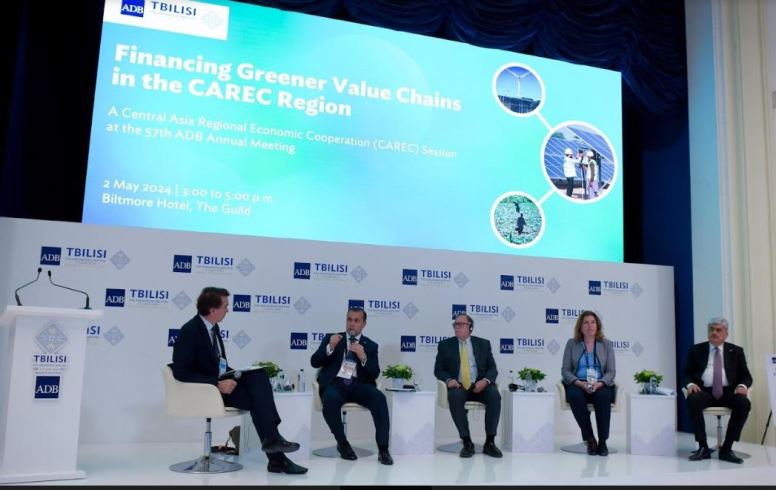
Closer cross-border collaboration and reforming trade policies in Central Asia and its neighbors can cut the carbon footprint of trade and value chains—a growing source of emissions in one of the world’s most energy-intensive regions for manufacturing—officials from the Asian Development Bank (ADB) said at the Bank’s 57th Annual Meeting in Tbilisi, Georgia on May 2.
“Harmonizing policies and standards through the ADB-supported Central Asia Regional Economic Cooperation (CAREC) Program can help to increase trade while making supply chains less carbon-intensive and more resilient,” said ADB Director General for Central and West Asia Yevgeniy Zhukov.
While trade has significantly propelled economic growth and development, it has also increased carbon emissions. About 20%–30% of global carbon dioxide emissions are associated with trade and supply chains, according to the World Trade Organization (WTO).
Most CAREC countries reportedly specialize in emission-intensive sectors such as electricity, chemicals, and mining. This results in the CAREC region having one of the highest shares of carbon dioxide emissions in the world in value-added manufacturing.
With its vast reserves of critical minerals which play a vital role in the energy transition—from wind turbines to electric vehicles and battery storage—CAREC countries have the potential to shift away from fossil fuels and take advantage of the market opportunities resulting from the energy transition.
CAREC needs a regional approach to developing green standards to help its businesses and producers remain competitive amid growing environmental standards and carbon pricing policies. Coordinated regional decarbonization policies and carbon pricing could lead to better use of regional resources, enhanced economic integration, reduced carbon leakage, and increased technology transfer.
“With support from its development partners, CAREC is also working to increase climate financing that will help accelerate member countries’ transition to clean energy and strengthen their resilience against climate change impacts,” said ADB Regional Cooperation Head for Central and West Asia Lyaziza Sabyrova.
The CAREC Program is a partnership of countries in Central Asia, the Caucasus, and East Asia, and development partners working together to promote sustainable development, accelerate economic growth and reduce poverty. ADB hosts the CAREC Secretariat.
Established in 1966, the Asian Development Bank is owned by 68 members—49 from the region.