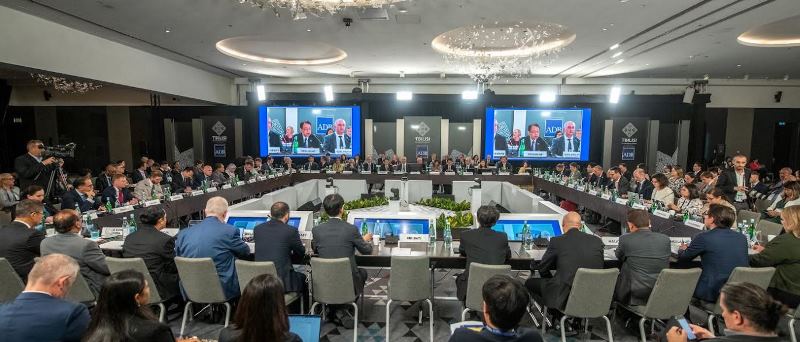
The Asian Development Bank (ADB)’s annual meeting is often a placid affair, offering bankers and stakeholders a chance to highlight accomplishments and discuss future challenges. The 57th edition of the ADB meeting was a bit different, however.
Eurasianet says the ADB came under withering criticism from non-governmental activists from across Georgia’s capital Tbilisi, were this year four-day gathering concluded on May 5, has been the scene of mass protests against a different government bill that critics say would muzzle the country’s NGO sector and independent press.
A coalition of NGO’s denounced the Bank’s “detrimental impact on communities, environments, and civic spaces.” The activists reportedly contend the Bank is ignoring its commitments to meet standards for Environmental and Social Safeguarding” (ESF).
A statement released by the NGO coalition on May 1 says, “The Bank’s Draft ESF released in October 2023 reportedly fails to meet [the highest] standards.”
According to Eurasianet, the coalition also took the ADB to task for largely turning a blind eye to laws adopted by Kazakhstan and Kyrgyzstan, which give authorities sweeping powers to hamper watchdog activities undertaken by non-profit organizations and news outlets.
A coalition of rights and watchdog NGOs in Kyrgyzstan reportedly issued a separate appeal, calling on the ADB to take a clear stand on foreign agents’ laws, such as that implemented in April in Kyrgyzstan. The Kyrgyz activists said the ADB should develop a new consultative mechanism “to discuss and review policy and legislation impacting civil society space and media freedom.”
The statement added that the ADB should feel obligated to “raise concerns over shrinking civic space with the government of Kyrgyzstan to ensure that space for civil society and independent media remains open in Kyrgyzstan.”
The theme of this year’s ADB meeting was “Bridge to the Future,” and it brought together finance ministers, central bank governors, senior government officials, and representatives from the private sector, academia, media, and civil society from ADB’s 68 members. The roughly 3,000 participants reportedly discussed issues related to expanding trade via the so-called Middle Corridor route that crosses Central Asia and the Caucasus.
Tajik delegation that participated in this event was headed by Hokim Kholiqzoda, First Deputy Prime Minister, who is ADB Governor from Tajikistan, and it comprised Sulton Rahimzoda, Chairperson of the State Committee on Investment and State-owned Property Management (GosKomInvest), who is ADB Alternate Governor from Tajikistan.
Since Tajikistan joined ADB in 1998, the Bank has provided over US$2.6 billion in assistance to the country, including over 2 billion US dollars in grants. ADB’s 2021–2025 country partnership strategy for Tajikistan focuses on three strategic priorities: 1) structural reforms to enhance resource allocation and mobilization; 2) improving labor productivity through human capital development; and 3) fostering better livelihoods by investing in strategic infrastructure.
Established in 1966, the Asian Development Bank is owned by 68 members—49 from the region.