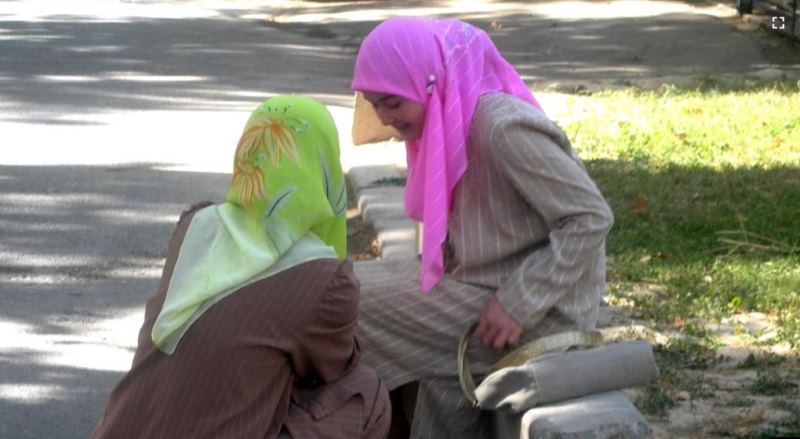
Thousands of women in Tajikistan are faced with the choice of either choosing a career or wearing Islamic hijab.
Radio Liberty’s Tajik Service, known locally as Radio Ozodi, says Dushanbe authorities has been increasingly cracking down on the Islamic head scarf at schools and workplaces.
Radio Ozodi notes that despite the effective ban on the hijab in public institutions, there is no legislation in Tajikistan that outlaws Islamic attire. But that is about to change.
Tajik parliament has reportedly adopted draft amendments to the law on “traditions and celebrations” that will ban the wearing, importing, selling, and advertising of “clothes alien to Tajik culture,” a term widely used by officials to describe Islamic clothing.
Lawmakers also approved new amendments to the code of administrative violations, which include hefty fines for offenders. The code did not previously list the wearing of a hijab or other religious clothing as violations.
Tajik lawmaker Mavloudakhon Mirzoyeva told Radio Ozodi that the amended version of the draft law “includes a ban” on clothes deemed foreign to Tajik culture.
The penalties for offenders vary from the equivalent of US$740 for individuals and to US$5,400 for legal entities. Government officials and religious authorities reportedly face much higher fines of US$3,700 and US$5,060, respectively, if found guilty.
The draft laws have been sent to the upper house of parliament (Majlisi Milli) and are widely expected to be approved and signed into law by President Emomali Rahmon.
Several Dushanbe residents told Radio Ozodi that they don’t support a ban on certain types of clothes because they believe people should be free to choose what clothes they want to wear.
Most Tajiks believe the new amendments would only legalize a “ban that has already been in place for years.”
The Tajik authorities’ clampdown on the hijab began in 2007 when the Education Ministry banned both Islamic clothing and Western-style miniskirts for students.
The ban was eventually extended to all public institutions, with some organizations demanding that both their staff and visitors remove their head scarves.
Local governments set up special task forces to enforce the unofficial ban, while police raided markets to detain “offenders.” But authorities reject numerous claims from women who said they were stopped on the street and fined for wearing the hijab.
The government in recent years conducted a campaign to promote Tajik national dress. On September 6, 2017, millions of cell phone users received text messages from the government calling for women to wear Tajik national clothes. The messages stated that “Wearing national dress is a must!” “Respect national dress,” and “Let us make it a good tradition to wear national clothes.”
The campaign culminated in 2018 when the government introduced a 376-page manual — The Guidebook Of Recommended Outfits In Tajikistan — which outlined what Tajik women should wear for different occasions.
Tajikistan has also unofficially banned bushy beards. Thousands of men in the past decade have reportedly been stopped by police and had their beards shaved against their will.