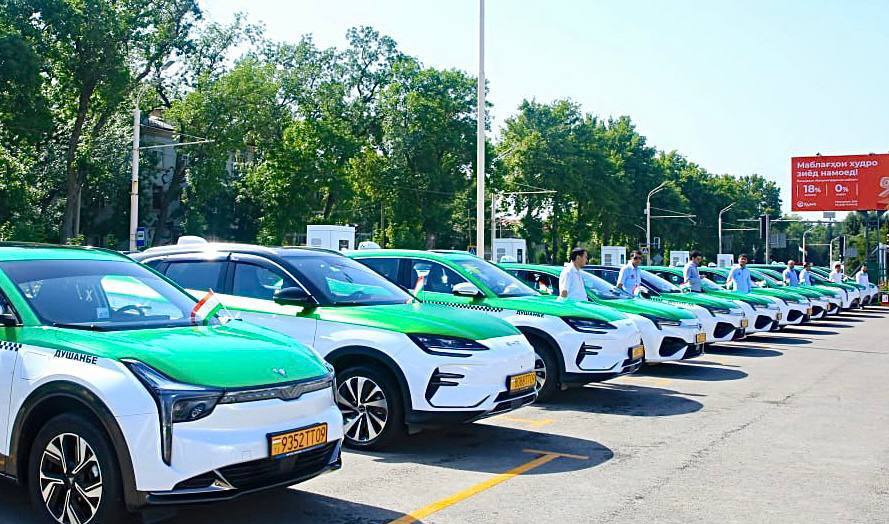
Dushanbe-based taxi companies must completely shift to electric taxi cabs until September 1, 2025.
The Dushanbe Administration press center says the Dushanbe Administration has adopted a decision on this subject within the framework of the implementation of the national electric transport development program designed for 2023-2028 and the concept for transition to electric transport designed for 2023-2026.
The report does not provide any other details.
Earlier it had been reported that about 230 million somonis (US$21 million) will be allocated within the next five years for development of electric transport in the country. Of this amount, 1.4 million somonis will be allocated from the national budget, 6.2 million somonis will be provided by development partners, and more than 221 million somonis will be provided by the private sector
An official source within the Dushanbe Administration says more than 4350 taxi cabs, within 2,450 of them being electric cars, have plied on Dushanbe streets as of June 1, 2024.
136 charging stations for electric vehicles have reportedly been established in Dushanbe as of June 6 this year.
There are a total of twelve taxi companies registered in Dushanbe.
In Tajikistan, mostly old foreign cars are in operation and their emissions are one of the main sources of air pollution. According to experts, gradually filling the country with electric cars could reduce air pollution.
Recall, Tajik President Emomali Rahmon in December 2021 proposed to completely waive taxes and customs duties on imports of electric vehicles — electric cars, electric buses, trolleybuses, etc.
He instructed the government to take measures to provide infrastructure and other necessary conditions for the use of such vehicles in the country.
A Dushanbe-based taxi company, Yak Tax, announced in Dushanbe 2022 that it will launch a new category on its app through which customers can book an electric vehicle for their rides.
Unlike the usual yellow cabs, electric taxi cabs are painted green.
An electric bus, assembled at the Akia Avesto plant in Dushanbe, appeared on the streets of Tajik capital in early December 2021.
According to Mr. Asror Mirzoyev, the Executive Director of Akia Avesto Automotive Industry Company, this electric bus can easily travel up to 200 kilometers on a single charge.
The gradual increase in electricity generation in Tajikistan reportedly allows increasing the number of electricity-powered vehicles in Tajikistan. Tajik officials say this will reduce the country's dependence on oil-exporting countries.
An electric car or battery electric car is an automobile that is propelled by one or more electric motors, using energy stored in batteries. Compared to internal combustion engine (ICE) vehicles, electric cars are quieter, have no exhaust emissions, and lower emissions overall. In the United States and the European Union, as of 2020, the total cost of ownership of recent electric vehicles is cheaper than that of equivalent ICE cars, due to lower fueling and maintenance costs. Charging an electric car can be done at a variety of charging stations; these charging stations can be installed in both houses and public areas.
Is Tajikistan ready for electric cars?
Tajikistan has huge reserves of energy resources, the first place is occupied by hydropower resources with a capacity of 527 billion kWh. According to this parameter, Tajikistan ranks eighth in the world in terms of hydropower potential relative to its area. 95% of the country's electricity is generated by hydroelectric power plants, including 94% at large and medium-sized hydropower plants.
According to data from the Ministry of Energy and Water Resources, the total capacity of the country’s hydropower plants increased from 1,100 MW in 2015 to 6,000 MW in 2020. It is expected to reach 10,000 MW by 2030.
Tajikistan's average annual electricity output, which is mainly generated by hydropower plants, is 17 billion kWh. Tajikistan's energy capacity is 5757 MW, of which 87.5% is hydropower. The share of CHP is only 718 MW, i.e. 12.4%.