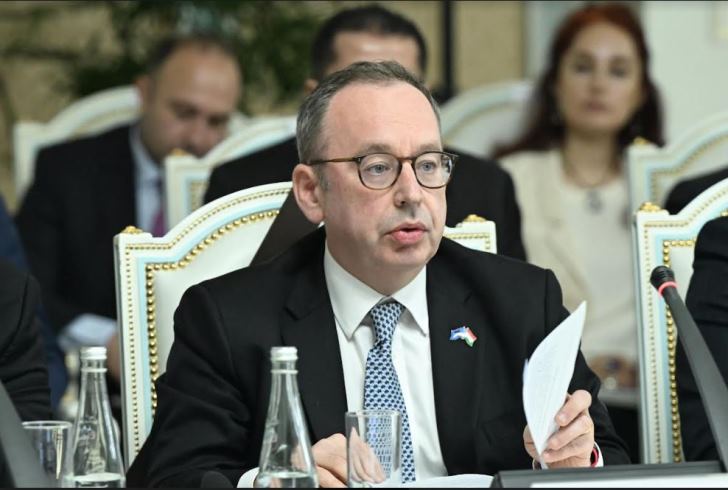
Asian Development Bank (ADB)’s Director General for Central and West Asia Yevgeniy Zhukov stressed the need to build resilience against the worsening climate crisis and extreme weather events and develop a strong private sector to ensure high-quality growth and development in Tajikistan, says press release issued by the ADB Tajikistan Resident Mission (TJRM).
Mr. Zhukov has visited the country to participate in the Third High-Level International Conference on International Decade for Action, “Water for Sustainable Development”, meet with the government on development priorities and ADB's assistance program, and visit project sites.
“ADB values its strong ties with Tajikistan and is committed to continue supporting the country to become more resilient and sustainable,” said Mr. Zhukov. “Going forward, ADB will look at all our projects through the lens of climate impact. We will also work harder on developing private sector investments in the country.”
According to the press release, Tajikistan faces significant climate challenges and risks that can lead to irreversible economic, social, and environmental damage. The country has lost an estimated 20% of its glaciers in the past 34 years. This poses a major threat to the economy, as the country is heavily dependent on glacier-fed rivers for irrigation and hydropower generation.
With ADB’s support, the government has reportedly prepared and approved the Green Economy Development Strategy up to 2027. The strategy outlines 11 priority areas, including energy efficiency, waste management systems, and ecotourism. The government and ADB will soon launch a Climate Finance Plan to increase access to domestic and international climate finance.
During his three-day stay in Tajikistan, Mr. Zhukov reportedly visited an ADB-funded irrigation project and a sediment excluding basin in Hamadoni district, Khatlon province. The basin reduces sediment deposits in irrigation canals and lowers damage to pumps for lifting irrigation water, thus improving agriculture production and food security in the country.
Tajikistan joined ADB in 1998. For 26 years, ADB has supported a wide range of sectors, from strategic road and energy infrastructure to health, education, agriculture, urban development, and finance for a total of over US$2.6 billion in assistance, including over US$2 billion in grants.
Established in 1966, the Asian Development Bank is owned by 68 members—49 from the region.