A report by the Asian Development Bank (ADB) notes that over the first six months of this year, Tajikistan’s economic growth has reached 8.2 percent.
Asian Development Outlook (ADO) September 2024, released today, says all sectors expanded, with services and agriculture contributing the most. Growth is expected to moderate in the second half of the year because tariff increases for electricity and irrigation water in January, and for broadband services in April, will slow business activity.
More stringent regulation of migrants in the Russian Federation will lower remittances, constraining growth. For these reasons, full-year growth forecast for Tajikistan is reportedly kept at 6.5 percent for 2024 and 2025.
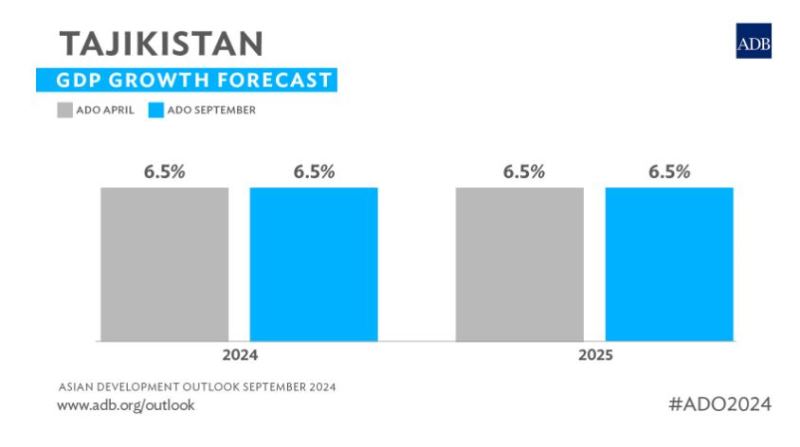
Inflation is projected to accelerate to 5.5 percent this year and 6.5% in 2025.
The Bank has reportedly raised its economic growth forecast for developing Asia and the Pacific this year, amid solid domestic demand and continued strength in exports. ADB has also lowered its forecast for regional inflation.
The region is forecast to grow by 5.0% this year, compared with a projection of 4.9% in April. The forecast for next year is maintained at 4.9%. Inflation in developing Asia and the Pacific is expected to ease further to 2.8% in 2024, compared with a previous forecast of 3.2%.
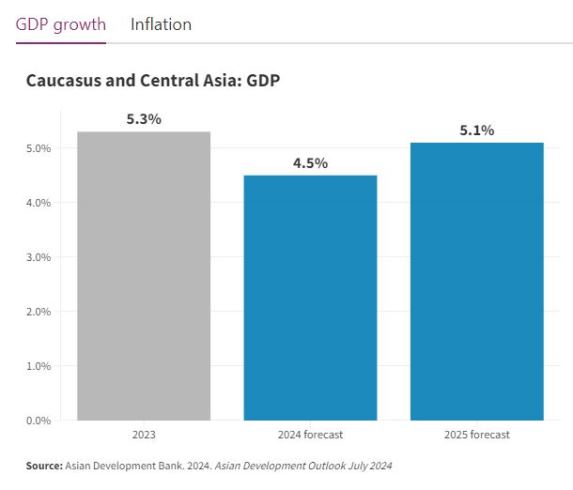
Meanwhile, Economic Forecasts for Asia and Pacific: July 2024 notes that the Caucasus and Central Asia growth forecast is revised up to 4.5% from 4.3% in 2024 and 5.1% from 5.0% in 2025, driven by stronger-than-expected growth in Azerbaijan and Kyrgyzstan. Economic activity in other subregional economies has been similarly robust. Armenia grew by 9.2% in Q1 2024, Georgia’s economy expanded by 9.0% in the first 4 months of 2024. Tajikistan reportedly continued its strong growth, at the rate of 8.2% in Q1 2024. Growth in Turkmenistan is driven by public investment and net gas exports. A surge in fixed capital investment in Uzbekistan reportedly led to 6.2% growth in Q1 2024.
Inflation forecasts for 2024 and 2025 in the Caucasus and Central Asia are revised down. The revised forecast mostly reflects lower-than-expected price levels observed in Armenia, Georgia, and Kyrgyzstan.
In Armenia, a strong local currency, among other factors, brought a 0.8% deflation in the first 5 months of 2024, a substantial decline from the 5.2% inflation in the same period of 2023. Amid currency appreciation, Georgia’s inflation for the first 5 months of 2024 was also limited to 0.9%. In Kyrgyzstan, inflation dropped to 4.6% in May 2024, primarily reflecting price movements of major commodities, from 11.3% a year ago. Inflationary pressures are also subsiding in other economies of the subregion. In January to May 2024, Kazakhstan’s inflation rate reportedly slowed to 9.0%, down from 18.5% in the same period in 2023, due to a stable exchange rate and relatively tight monetary policy. Tajikistan’s inflation was 3.8% in the first four months of 2024. In Uzbekistan, inflation decelerated to 9.2% in the first five months of 2024 from 11.4% a year earlier.