Tajikistan’s energy minister outlines 5 key arguments for achieving energy independence by May 2027

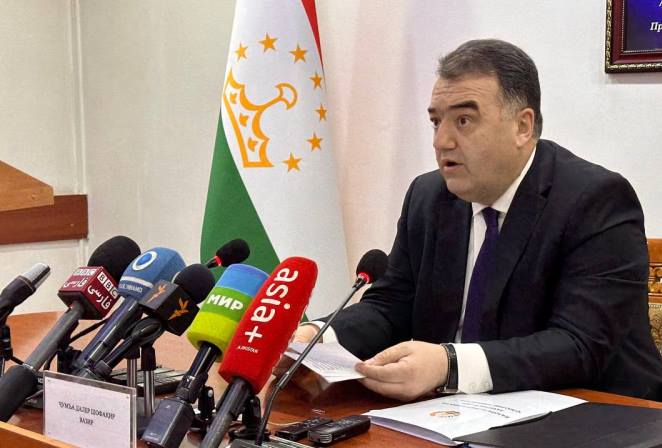
Daler Juma, Tajikistan’s Minister of Energy and Water Resources, has presented five key arguments supporting President Emomali Rahmon’s recent statement regarding the country's energy independence within the next 2 ½ years. In his latest address to a joint meeting of both chambers of parliament, the president declared that by May 2027, Tajikistan will completely eliminate […]

Asia-Plus

Daler Juma, Tajikistan’s Minister of Energy and Water Resources, has presented five key arguments supporting President Emomali Rahmon’s recent statement regarding the country's energy independence within the next 2 ½ years.

In his latest address to a joint meeting of both chambers of parliament, the president declared that by May 2027, Tajikistan will completely eliminate electricity shortages and achieve absolute energy independence.

According to Mr. Juma, Tajikistan currently faces a seasonal electricity deficit of 1.5 billion kWh during autumn and winter. To bridge this gap and ensure energy security, the government is working in five key areas:


1.     Expansion of Roghun hydropower plant (HPP)

·         The commissioning of the third turbine (Unit No. 4) at Roghun HPP and raising the reservoir level will triple the plant's capacity.

·         Additionally, water regulation from the Roghun reservoir will boost the capacity of downstream Vakhsh River hydropower plants by 400 MW.


2.     Launch of Sebzor HPP in GBAO

·         In 2024, the Sebzor HPP in the Roshtqal’a district of the Gorno Badakhshan Autonomous Region (GBAO) will be commissioned, adding 11 MW to the national grid.


3.     Modernization of Major Hydropower Plants

·         Reconstruction and modernization of the country's largest Nurek HPP, as well as Qayroqqum HPP and Sarband HPP, will increase total capacity by 431 MW by 2027.


4.     Reduction of energy losses

·         Cutting commercial electricity losses will lead to more efficient energy consumption among consumers.


5.     Development of solar power plants

·         By 2027, two solar power plants with a combined capacity of 400 MW will be operational.


According to the Ministry of Energy and Water Resources (MoEWR), Tajikistan’s installed power generation capacity is currently around 6,000 MW.

However, despite these developments, electricity shortages persist in rural areas.  While the energy distribution company claims that households in villages receive electricity for 8-10 hours daily, residents of rural areas report experiencing more frequent and prolonged outages, with some going entire days without power.
Join us on social media!

Article translations:

Related Article

Оби зулол
Оби зулол

Most Read

Recent Articles

The only GPW veteran in Dushanbe allocated more than 80,000 somoni

The mayor's office of Dushanbe allocated him 25,000 somoni.

GITEX AI Kazakhstan 2026: how Almaty became the main AI hub of Central Asia

More than 300 companies and startups, over 200 speakers and 100 investors from 50 countries — the region is entering the global stage.

A trade and economic park to be built at the border junction of Tajikistan, Kyrgyzstan, and Uzbekistan

President of the Kyrgyz Republic Sadyr Japarov familiarized himself with the project.

A project to protect soil from degradation to be developed in Central Asia

The initiative is of great significance for the mountainous countries of the region, including Tajikistan.

Mudslide, death, and destroyed homes: hundreds of families in Tajikistan left homeless

A correspondent from "Asia-Plus" visited Kulob and spoke with the families of those who died and were affected by the disaster.

Spring 2026 bright event: new issue of VIPzone now on sale

This issue is about people and ideas that change everything: from business and investments to fashion, food, and urban environment.

Godfrey Sullivan: “Tajikistan is a promising market for Visa to develop digital payments”

The Vice President of Visa explained why Tajikistan is becoming a promising market for digital payments and how artificial intelligence is influencing the future of finance.

Seven students in Dushanbe were threatened with expulsion for arriving at universities in personal cars

The materials for each case have been sent to the Ministry of Education and Science for appropriate actions.

India’s blockchain push and lessons for the global south

The Indian Government has started pushing aggressively its agenda...

India’s blockchain push and lessons for the global south

The Indian Government has started pushing aggressively its agenda...