
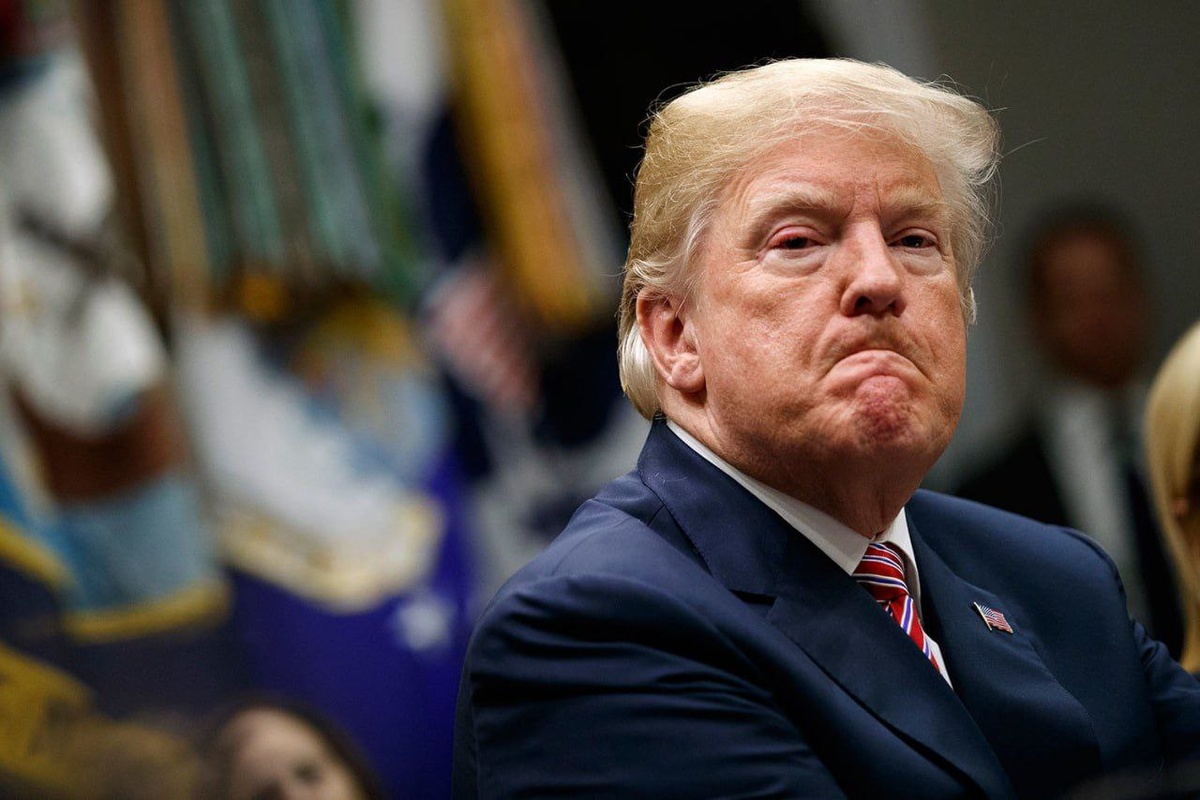
Tajik political scientist Muhammad Shamsuddinov notes that the foreign policy actions of the 47th President of the United States since taking office have sparked heated discussions in the global community, including in Central Asia. In particular, his decisions to suspend the activities of USAID and Radio Free Europe/Radio Liberty, which have significant positions in the region, have been actively debated in society. Current decisions being made in Washington are often linked to the personalities of one or two individuals. But is this truly the case?
New U.S. foreign policy priorities
The expert says that since the second half of the 2010s, particularly after Donald Trump's first term in the White House, the U.S. began radically reassessing its foreign policy priorities. According to him, this process was not only linked to the personality of the 45th president, with whom many aspects of both domestic and foreign policy are associated (although he had some influence), but was also driven by a number of systemic factors.
The first factor is the overheating of the "globalist" American foreign policy. This means the overstretching of American resources due to the active global engagement of the U.S., which has lasted for several decades, particularly after the collapse of the USSR. Washington has long been increasingly defining the zone of its national interests on a global scale, taking this process to extremes. This would inevitably lead to the overheating of the American economy and a corresponding reduction in global activity.
The second factor is the shifting center of the global economy and politics to Asia, especially the Asia-Pacific region (APR). In historical and international relations scholarship, the 21st century is being declared the "century of Asia," which signifies the growing importance of Asia in the modern world. The APR is reportedly becoming a new engine of the global economy with massive industrial and trade growth. Alongside this process, nationalism is rising in the region, with growing national pride among Asian peoples and militarization. All of this is leading to an increase in geopolitical competition and carries a tremendous potential for destabilization.
The third factor is China. The expert notes that over the past fifteen years, China has dramatically changed in terms of its potential and foreign policy priorities. In 2010, China's economy surpassed Japan's, becoming the second-largest in the world, continuing to grow at a rapid pace. While in early 2000s the West had significant doubts about China's technological advancements, by the 2010s, China's success in technology, especially in cutting-edge fields, became a source of fear.
With the arrival of the "fifth generation" of leadership in China, headed by Xi Jinping in 2012, “Socialism with Chinese characteristics entered a new era.” This reportedly signaled ambitious changes in Beijing's domestic and foreign policy. China began to perceive itself as a global power that must play a decisive role in world affairs. In connection with this, the Communist Party of China (CPC) announced the “Chinese Dream,” which means the achievement of the goal of transforming the country into “a great, strong, and modernized state” by the centenary of the founding of the People's Republic of China; in other words, into a superpower.
In practice, China's ambitions can be seen in the global geoeconomic project “Belt and Road Initiative.” It is important to note that the key region where China aims to intensify its trade, economic, and military-strategic presence is the APR.
Thus, these three factors compel the U.S. to reassess its foreign policy priorities: firstly, to distribute its resources more rationally; secondly, to contain China's growth; and thirdly, to prevent China's dominance in the APR. In other words, for the U.S., the new region of primary focus is the APR, and the new geopolitical rival is China.
Consequences for Central Asia
Shamsuddinov notes that the former Soviet space, including Central Asia, is still perceived by the West as a unified geostrategic field, although it is recognized that significant changes are taking place in this space due to the strengthening of the subjectivity of the new independent states and the influence of external players.
The expert emphasizes that, by reassessing its foreign policy priorities, the U.S. seeks to shift the responsibility for Europe and the CIS to its European allies. In particular, the U.S. is attempting to transfer responsibility for containing Russia.
If this policy is implemented, it could lead to an increased European presence in Central Asia by replacing some of the U.S. positions, particularly in the humanitarian sphere and "soft power." This means that the EU and European countries will invest more resources in these areas, expanding their activities in this direction, which were previously largely the prerogative of the U.S.
