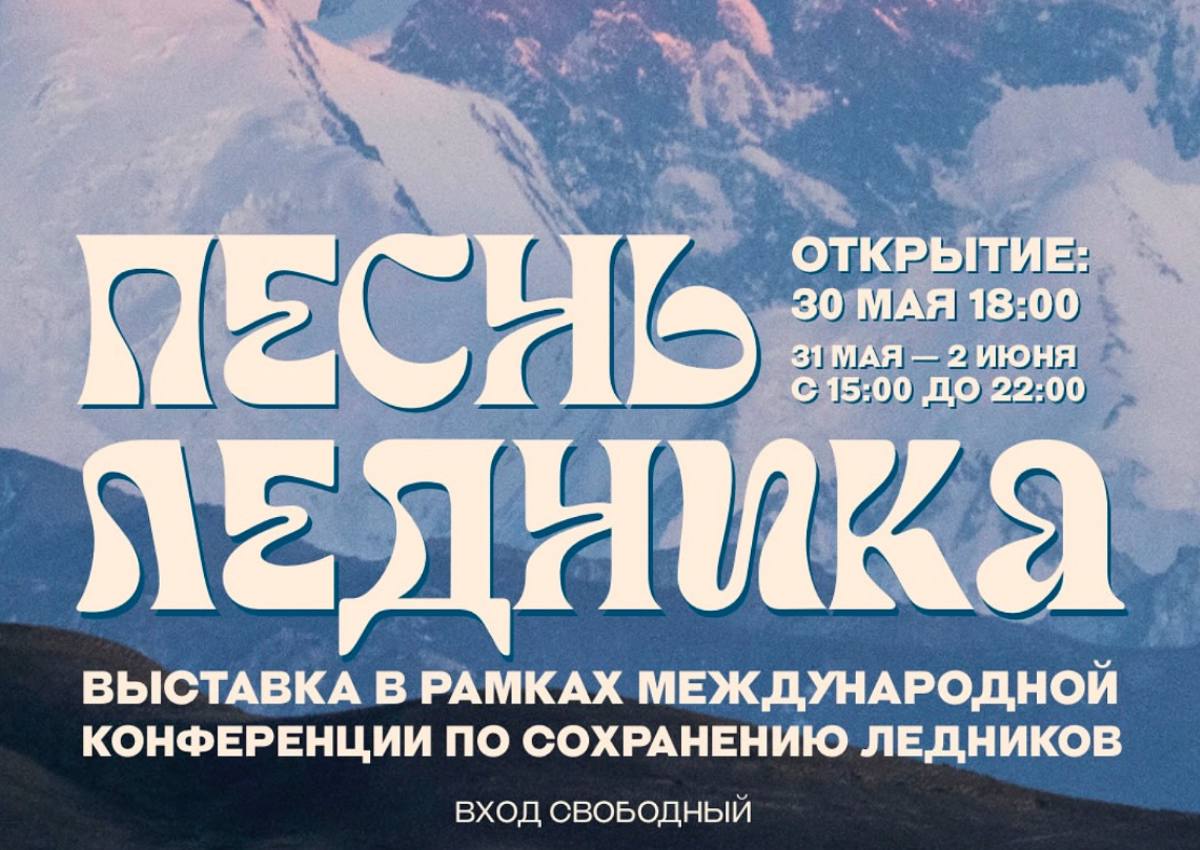
From May 30 to June 2, the “Boghi Iram” Park (Dushanbe Botanical Garden) will host the multimedia eco-art exhibition “Song of the Glacier,” dedicated to the International Year of Glacier Preservation. Supported by the Swiss government, the project combines contemporary art, science, performance, and education.
This is not just an exhibition but a full immersion into the world of melting glaciers — one of the 21st century’s most pressing ecological challenges.
Through sound, light, performance, animation, and installations, artists and researchers from Kyrgyzstan, Uzbekistan, and Tajikistan tell the story of ice not as mere cold but as the living memory of our planet.
“A united team from three countries aims to create a dialogue to collectively reflect on the fragility of nature and the global climate crisis,” organizers say.
The exhibition features seven fabric tunnels, an ice installation, and collaborative works produced during three workshops on animation and visual storytelling, body-sound improvisation, and musical instrument creation. On June 2, a live performance led by vocalist and sound designer Arlayym Guvayda will cap the event.
“Visitors choose their own path through the exhibition — from the global to the personal or vice versa. It is a visual, auditory, and tactile journey where the disappearance of glaciers feels like a loss of our shared past,” the organizers note.
Why is this important, and why use art?
Because glaciers are melting now. Over the past 30 years, Tajikistan, Kyrgyzstan, and Kazakhstan have lost 30% of their glaciers. By 2040, losses are expected to reach another 35%. Switzerland experienced a record 6% loss of ice volume in 2022 alone, according to the Swiss Glacier Monitoring Network (GLAMOS).
Science sounds the alarm, but numbers don’t always move people. Art does. It engages, evokes feelings, makes people pause and reflect. The exhibition invites audiences to see the issue differently — through emotions and imagery, through nature’s poetry, the sound of time, and voices that may soon vanish forever.
Why should you visit?
Because “Song of the Glacier” is an informal conversation with society about climate. It offers a unique artistic experience that resonates deeper than lectures or statistics. It educates on ecology in a way that reaches those usually distant from science. Most importantly, it invites people to feel part of a larger global dialogue about the planet’s future, with Tajikistan playing a vital role.
“It is important that visitors, once inside the installation resembling fragile glacier bodies, sense the silence, emptiness, and fragility — all that remains afterward. It’s about slowing down internally, paying attention to oneself and the world around, moments before they dissolve. We invite you to feel this,” says project curator Diana Rahmanova.