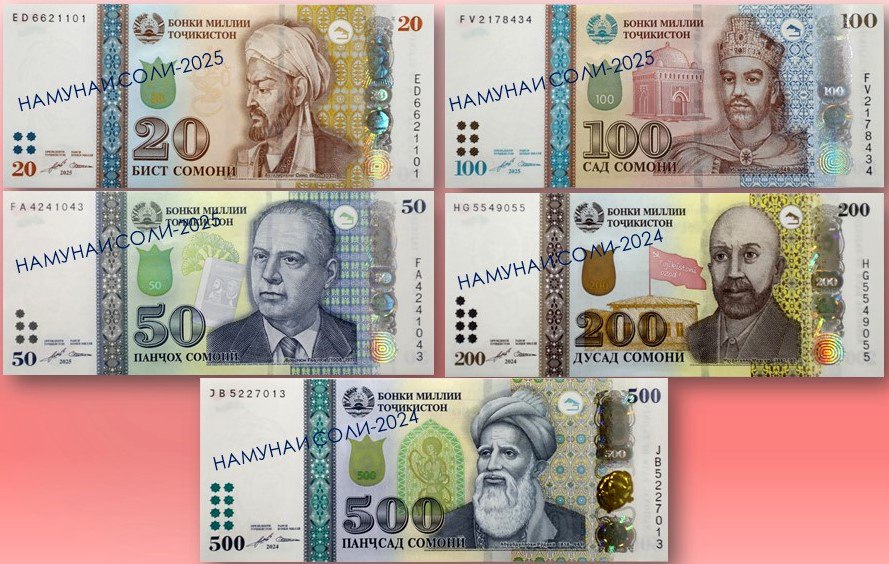
On July 3, the National Bank of Tajikistan (NBT) announced the release and circulation of newly designed banknotes from the 2024 and 2025 series.
According to the NBT, the new banknotes include the 200 and 500 somoni denominations from the 2024 series, along with 20, 50, and 100 somoni bills set for release in 2025.
The decision was approved by the NBT Board in accordance with the Law “On the National Bank of Tajikistan” as part of efforts to ensure the economy is adequately supplied with national currency.
The central bank emphasized that the introduction of the new notes aims to support the stability and development of the national economy. The banknotes are produced using modern technologies and meet current standards for security and user convenience.
Importantly, the newly issued banknotes from the 2024 and 2025 series — covering 20, 50, 100, 200, and 500 somoni — will circulate alongside the current notes of the same denominations.
History of Tajikistan’s cash system
After Tajikistan gained independence in 1991, the Soviet ruble remained in circulation on the territory of the country until the end of 1993, since January 1, 1994 it was replaced by the Russian ruble, and on May 6, 1995, the Tajik ruble appeared.
The current national currency – somoni, named after the medieval politician Ismoili Somoni, was introduced into circulation on October 30, 2000.
Banknotes in denominations of 1.5, 10, 20, 50, 100 somoni and a change unit in denominations of 1, 5, 20, 50 dirams were issued into circulation.
On the banknotes of the new currency were portraits of prominent figures of modernity and the past of the Tajik people, as well as images of architectural and historical monuments of Tajikistan, objects of applied art and everyday life of the Tajik people.
On September 3, 2001, metal coins were issued in denominations of 1, 3, 5 somoni and 5, 10, 20, 25, 50 diram. These coins were minted at the enterprises of the St. Petersburg Mint of the Russian Federation.
In December 2012, modifications of 5 and 10 somoni banknotes with an additional holographic security element were issued.
Since March 5, 2013, modifications of banknotes in denominations of 20, 50 and 100 somoni have been introduced, with a new security element: the last three numbers of the serial number are printed on the kinegram using a laser and have an increased relief that can be distinguished with the naked eye and by touch.
On August 31, 2017, NBT issued modifications of 10, 20, 50 and 100 somoni banknotes with new security elements. All banknotes changed the signature of the NBT chairman.
The security stripes on the front side of the 100 somoni banknote have been changed, the bank's emblem has been reduced. On the reverse side of the banknote, the diving thread became wider, the flag of the republic and the emblem of the bank were also reduced.
By the way, in September 2016, the director of the branch of the State Unitary Enterprise “Tajiksugurta” in Shahrinaw Sharif Karimov, in his article published in Tajikistan newspaper, proposed to issue 1000 somoni banknotes with the image of the President of Tajikistan Emomali Rahmon.