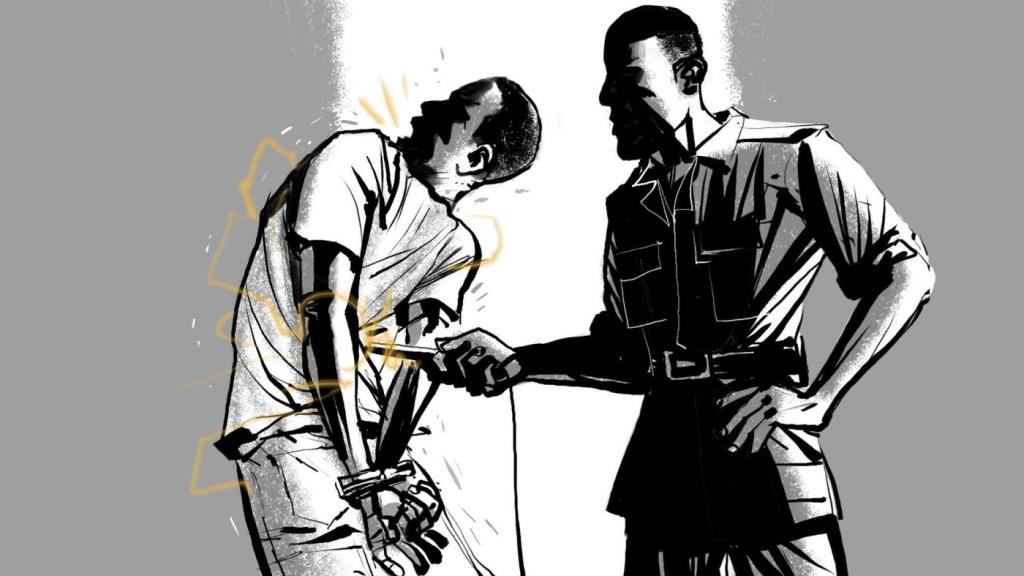
Dozens of detainees and their families in Tajikistan file complaints each year about torture during arrest or interrogation. Yet in most cases, authorities deny the use of torture, and criminal investigations against law enforcement officers are launched only in exceptional cases.
Khushbakht Isoyev, a documentation specialist at the civil society group Mir Prava and a member of Tajikistan’s Coalition against Torture, says the situation has been slowly improving in recent years. There has been a slight increase in official investigations, criminal cases, and convictions related to torture, alongside stronger legislation and more international scrutiny.
However, in practice, torture still occurs—particularly at the time of arrest. In 2024 and the first half of 2025, the Coalition against Torture recorded 25 complaints involving Tajik security agencies. These included:
- 17 cases involving the Ministry of Internal Affairs;
- 4 cases involving the State Committee for National Security (SCNS);
- 1 case each involving the anticorruption agency, the Drug Control Agency, and the Prosecutor-General’s Office.
Of those affected, 11 people received legal representation and 14 were given legal advice. The Coalition provided 102 verbal consultations and prepared 72 legal documents on behalf of the complainants.
Criminal cases are not always opened, as allegations of torture often lack sufficient evidence or are denied outright. Of the complaints, 11 came from Sughd province, 6 from Dushanbe, 4 from cities and districts subordinate to the center, and 4 cases came from the Gorno-Badakhshan Autonomous Region (GBAO). Authorities have launched five new criminal cases and reopened one that had remained inactive for seven years due to the suspect’s disappearance.
Some defendants have already been convicted, while others are awaiting verdicts.
Legal reforms are not enough — structural change needed
Isoyev notes that the inclusion of a specific article on torture (Article 143(1)) in Tajikistan’s Criminal Code, replacing the broader classification under “abuse of power,” was an important legal step. However, he emphasizes that without systemic reforms in law enforcement, prosecution, oversight, and victim protection, meaningful progress remains out of reach.
According to UN and international best practices, the most effective approach to eradicating torture is the establishment of an independent and empowered mechanism for preventive monitoring and rapid response. Investigations into torture cases must be conducted by impartial bodies, not the same agencies accused of abuse—a recurring problem in Tajikistan that perpetuates impunity.
Other essential measures include mandatory video recording of interrogations and detainee custody, the installation of tamper-proof surveillance in police stations and detention centers, and regular unannounced inspections of closed institutions.
Training is also vital. Isoyev stresses the need for consistent education on anti-torture standards for law enforcement officers, lawyers, detainees, and prisoners. Together, these actions would help build a functioning prevention and protection system.
Ultimately, the absence of a truly independent investigative body and the reliance on compromised institutions remain the greatest barriers to justice for torture victims in Tajikistan. Unless these structural issues are addressed, torture is likely to remain a persistent problem in the country.