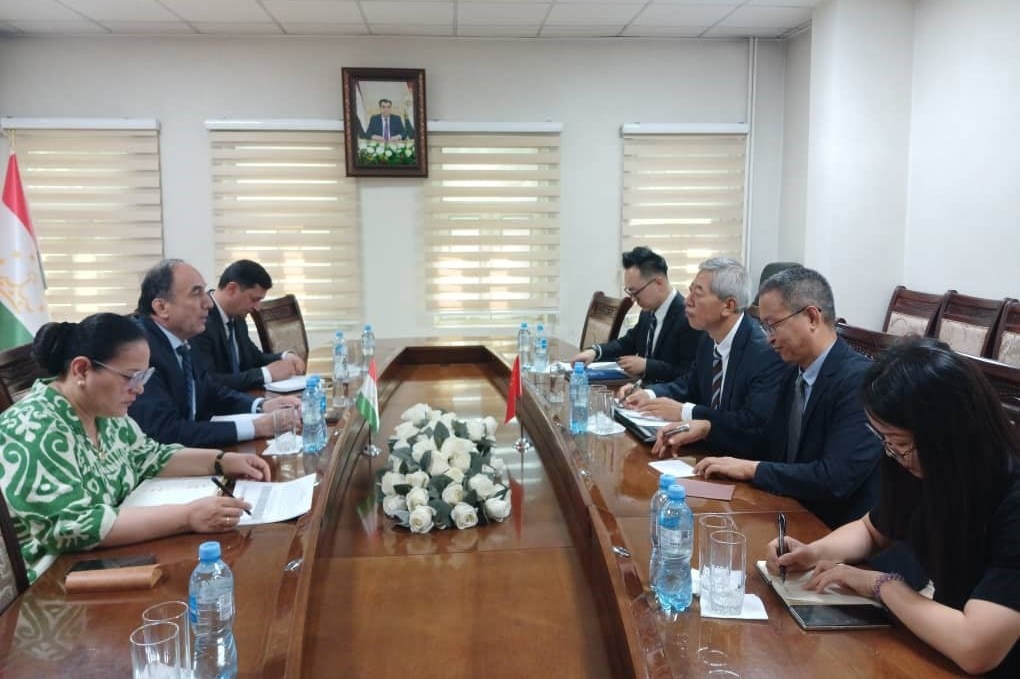
The Minister of Transport of Tajikistan, Azim Ibrohim, discussed with the Chinese Ambassador to the Republic, Guo Zhijun, the prospects for bilateral cooperation in the field of transport and international transportation, the press service of the Ministry of Transport of the Republic of Tajikistan reports.
Special attention was paid to the expansion of partnership in the construction and modernization of road infrastructure in Dushanbe and the regions of Tajikistan.
Construction of two-level roads in Dushanbe
The parties reached an agreement to strengthen work on the construction of two–level interchanges in the capital – at the intersection of Abaya – A. Kakhkhorov, A. Dzhomi – A. Kakhkhorov and Yuzhnaya – A. Kakhkhorov streets.
It is noted that the development of a feasibility study for these projects has been completed, and the process of its approval with the Chinese side is currently underway. After the documentation is approved and the contractor is selected, the main construction work will begin.
International transport corridors
A separate point of the meeting was the promotion of international transport routes China – Tajikistan – Uzbekistan – Turkmenistan – Iran – Turkey – Europe and China– Tajikistan –Afghanistan. The cooperation provides for access to the seaports of Chabahar (Iran) and Karachi (Pakistan), as well as integration into the Belt and Road Initiative.
It should be recalled that bilateral cooperation in the field of transport is carried out on the basis of the intergovernmental agreement on international road transport, signed on August 28, 2008 in Dushanbe.
Uninterrupted movement of goods and products is ensured through the Kulma–Karasu border crossing within the framework of the joint mechanisms of Tajikistan and the Xinjiang Uygur Autonomous Region of China.
Cooperation is also developing within the framework of regional and international organizations – the SCO, ESCAP, the United Nations and the Central Asian Regional Economic Cooperation (CAREC) program.
The "One Belt, One Road"
The initiative was proposed in 2013 by Chinese President Xi Jinping and was one of the first to receive the support of Tajik President Emomali Rahmon. It involves the formation of energy, transport and trade corridors between China and the countries of Central Asia, Europe and the Middle East.
Today, more than 130 agreements have been signed with 100 states within the framework of the initiative. For Tajikistan, it is considered as an additional source of financing for the implementation of the "National Development Strategy until 2030" and the achievement of the Sustainable Development Goals.
One example of cooperation is the project "Reconstruction of the Dushanbe–Kulma highway, the Kalaikhumb–Vanch section – the border of the Rushan district". It is planned to build 93 km of roads, two tunnels with a total length of 5.2 km, five anti-avalanche corridors (602 meters), 15 bridges (633 meters), almost 22 km of protective walls, more than 150 artificial structures and other facilities.