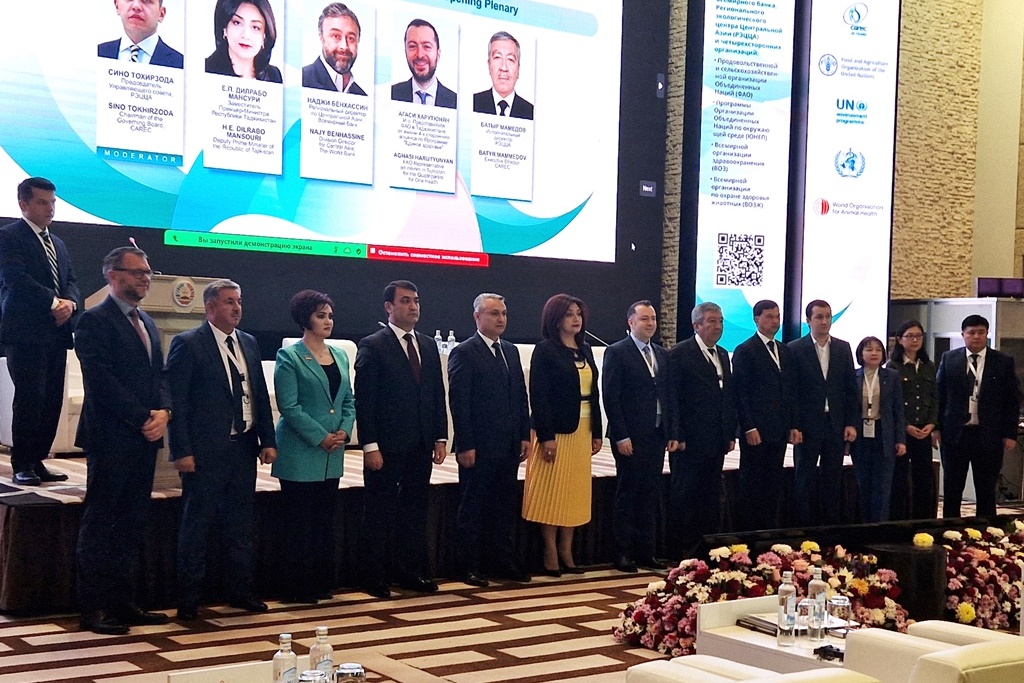
From October 29 to 31, the capital of Tajikistan hosted a regional conference and the first meeting of the Regional Coordination Council on "One Health." The event brought together representatives from all Central Asian countries, international organizations, and leading experts to discuss strategies for preventing future pandemics, building resilient food systems, and protecting ecosystem health in the region.
The conference was organized by the Government of Tajikistan in partnership with the World Bank, the Regional Environmental Centre for Central Asia (CAREC), and the Quadripartite Alliance on One Health, which includes the Food and Agriculture Organization (FAO), the World Health Organization (WHO), the World Organization for Animal Health (WOAH), and the UN Environment Programme (UNEP).
A region at risk: health and environmental threats
Experts noted that Central Asian countries continue to face serious health threats, including the emergence and re-emergence of zoonotic diseases, antimicrobial resistance, and food safety challenges. Migration of wild animals, land degradation, and climate change further exacerbate these risks, while the region still lacks robust mechanisms for cross-border cooperation.
Tajikistan steps up action
Opening the conference, Tajikistan’s Deputy Prime Minister Dilrabo Mansouri emphasized on October 29 that the region remains highly vulnerable due to shared ecosystems, climate pressure, and heavy reliance on livestock. She outlined steps taken by the government, including a joint external evaluation of health and veterinary services, expansion of the National Health and Social Protection Coordination Council’s mandate, and the development of a national roadmap and action plan to combat antimicrobial resistance.
World Bank: high returns on investment
World Bank Regional Director for Central Asia, Najy Benhassine, presented findings showing that annual investments of $1.9 billion to $3.4 billion in "One Health" systems could deliver a return of at least 45% and help prevent moderate pandemics. He referred to antimicrobial resistance as a “silent pandemic” that has already caused thousands of deaths in the region.
He added that brucellosis, a disease transmitted from animals to humans, could cost the region up to $1.15 billion between 2023 and 2048 if current trends continue, with two-thirds of losses stemming from reduced productivity and trade in livestock products.
The region has also secured a $27 million grant from the Pandemic Fund. The first phase of the program includes a $30 million concessional loan for Kyrgyzstan and a $30 million grant for Tajikistan. In total, the program envisions $130 million in support for Kazakhstan, Kyrgyzstan, Tajikistan, Turkmenistan, and Uzbekistan.
One Health: a necessity, not a choice
CAREC Executive Director Batyr Mamedov warned of the rising threat of antimicrobial resistance, calling it one of the most dangerous global challenges. In 2019 alone, it caused nearly 13,000 deaths in Central Asia and neighboring regions. If trends continue, global economic losses could exceed $100 trillion by 2050.
Agriculture in focus
Tajikistan’s Deputy Minister of Agriculture, Nigina Anvari, emphasized the importance of the agricultural sector to the national economy. With over 2.7 million head of cattle, 7.5 million small livestock, and more than 13 million poultry, she stressed the need to implement "One Health" measures immediately.
She also cited successful cooperation with Kyrgyzstan in preventing a zoonotic outbreak in 2023 and noted that "One Health" modules have been introduced into the curriculum of the Tajik Agrarian University.
“It’s crucial to train not just veterinarians or agronomists, but develop interdisciplinary specializations. Doctors, ecologists, veterinarians, and agronomists must work together,” she said.
The "One Health" program is set to run through 2032 and aims to build a robust regional framework for early response to health, agricultural, and environmental threats.