
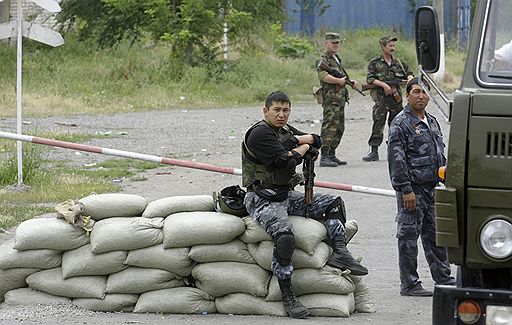
DUSHANBE, October 30, 2014, Asia-Plus – Kyrgyzstan’s parliament has passed a law providing for formation of something like civilian militias to help border guards.
Vesti.kg reports that the law was passed on October 9 and under this document, residents of border villages will be got involved in patrolling the border.
The law reportedly provides for arming elements of the population living in border areas and training them to work with local border-guard units. These border-guard helpers would be used in remote mountain areas.
The state will provide them with uniforms and mobile-communications equipment and pay them a wage for helping border guards keep the watch.
Meanwhile, Radio Liberty reported on October 14 that Uzbekistan’s government on October 6 approved regulations for the Chegara Posbonlari (Border Sentinels), volunteer units to assist border-guard forces. The pro-government youth group Kamolot formed such volunteer units — Kamolot Posbonlari — back in 2010 to help patrol borders with Kazakhstan and Tajikistan.
According to Radio Liberty, none of the five Central Asian states can claim to have all of its borders demarcated. The Uzbek-Kyrgyz border might be the worst-defined frontier within Central Asia.
The combination of illegal activity and an unclear border has fueled conflicts between communities on opposite sides of the boundary. Border guards have often been needed to restore peace between Uzbek and Kyrgyz villagers, but they do naturally tend to side with their countrymen in these disputes.
There is no reason to believe the introduction of these semi-official civilians into the mix would ease, rather than stoke, these conflicts, Radio Liberty noted.
The situation along Tajikistan’s border with Kyrgyzstan is similar to the situation along the Kyrgyz-Uzbek border.
Border guards — Kyrgyz, Tajik, and Uzbek — exchange fire across the borders of the Ferghana Valley every year. People are often wounded and sometimes killed.
Experts note that adding civil-defense units is likely to bring more casualties and further escalate tensions.