
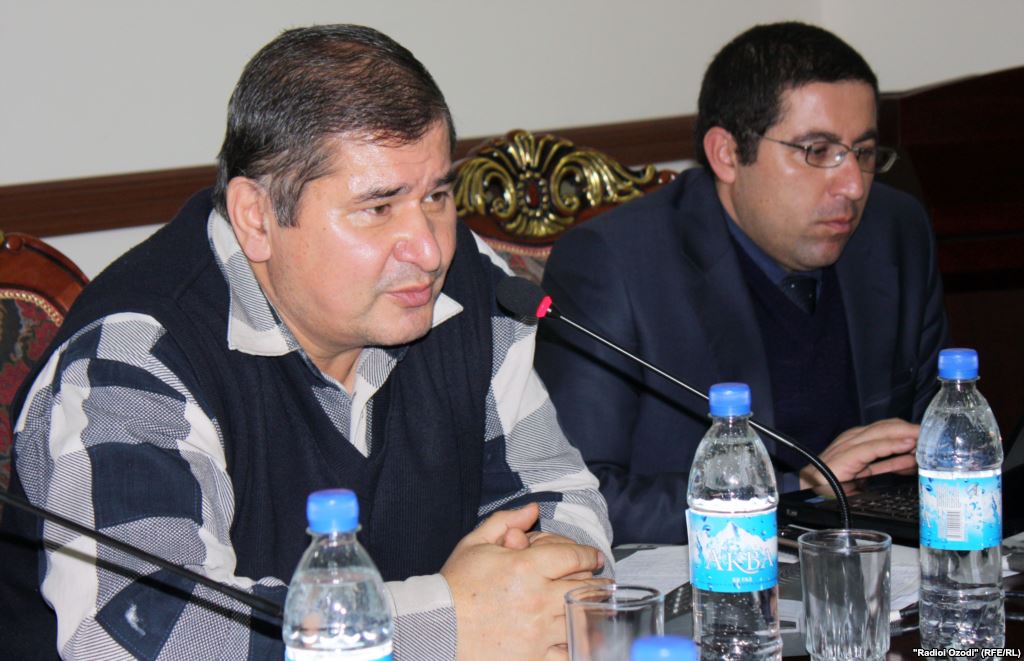
DUSHANBE May 29, 2013, Asia-Plus – New head of the OSCE office in Tajikistan, Ambassador Markus Mueller, has met with leaders of Tajik political parties.
Senior representatives of all eight political parties of Tajikistan attended the meeting that took place on May 28.
Speaking at the meeting, Rahmatillo Zoirov, leader of the Social-Democratic Party of Tajikistan (SDPT), noted that the presidential election year would be very hard and it would be a democracy exam for all, including the new head of the OSCE Office.
“The presidential election year will be real test not only for all political parties of the country but also for the OSCE Office, which has lost its image over the past ten years, especially because participating in elections as an international observer it has made resolutions that do not meet with support from the Organization top leadership,” Zoirov said.
During the meeting, representatives of political parties were speaking mostly about what they are expecting from the OSICE.
“We do not need your help; we need your position, your adherence to principles,” SDPT leader stated.
The meeting participants also discussed issues related to establishing a coalition to fight elections. They came to a conclusion that no permissions are needed for establishment of the election coalition and there are no legislative bans on establishment of the coalition.
“The only problem is the fact that the electoral block of the collation of political parties cannot be party of the election process, that is it cannot nominate candidates for presidential or parliamentarian elections,” Zoirov said.
The OSCE first established a presence in Tajikistan in early 1994 when it opened the Mission to Tajikistan. In October 2002, it was renamed the Center in Dushanbe and its tasks were broadened. In June 2008, it became the Office in Tajikistan, following Decision 852 by the OSCE Permanent Council.
The Office, which is based in the Tajik capital Dushanbe, has five field offices in Gharm, Khujand, Kulob, Qurghon Teppa and Shahritous. OSCE activities in the country fall into one or more of the following areas: politico-military dimension of security; human dimension of security; and economic and environmental dimension of security