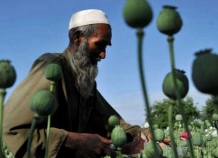
DUSHANBE, October 22, 2014, Asia-Plus — Opium poppy cultivation in Afghanistan hit record levels in 2013 despite counter-narcotics efforts by Washington, Special Inspector General for Afghanistan Reconstruction (SIGAR) noted in its report.
The report notes that according to the United Nations Office on Drugs and Crime (UNODC), Afghan farmers grew an unprecedented 209,000 hectares of opium poppy in 2013, surpassing the previous peak of 193,000 hectares in 2007. With deteriorating security in many parts of rural Afghanistan and low levels of eradication of poppy fields, further increases in cultivation are likely in 2014. Despite this, Afghanistan grew 209,000 hectares of the plant in 2013.
As of June 30, 2014, the United States has reportedly spent approximately $7.6 billion on counternarcotics efforts in Afghanistan. Multiple sources of funding support these efforts, including the Department of Defense (DOD) Afghan Security Forces Fund, the State Department”s (State) International Narcotics Control and Law Enforcement fund, the DOD Drug Interdiction and Counter-Drug Activities fund, financial support from the U.S. Drug Enforcement Administration, and the U.S. Agency for International Development’s Economic Support Fund.
The report says counternarcotics efforts include the development of Afghan government counternarcotics capacity, operational support to Afghan counternarcotics forces; encouragement of alternative livelihoods for Afghan farmers; financial incentives to Afghan authorities to enforce counternarcotics laws; and, in limited instances, counternarcotics operations conducted by U.S. authorities in coordination with their Afghan counterparts.
Despite the significant financial expenditure, opium poppy cultivation has far exceeded previous records, SIGAR concluded in its report. Affordable deep-well technology has turned 200,000 hectares of desert in southwestern Afghanistan into arable land over the past decade. Due to relatively high opium prices and the rise of an inexpensive, skilled, and mobile labor force, much of this newly-arable land is dedicated to opium cultivation.
The report also found that areas such as Nangarhar in the east of the country, which was previously declared “poppy-free,” saw a fourfold increase in opium poppy cultivation between 2012 and 2013.
The UNODC estimates that the value of the opium and its derivative products produced in Afghanistan was nearly $3 billion in 2013, up from $2 billion in 2012. This represents an increase of 50 percent in a single year.
Afghanistan is responsible for producing about 80% of the world”s opium.
Profits from the trade help fund corruption within the country, maintain criminal networks and support terrorist groups such as the Taliban.