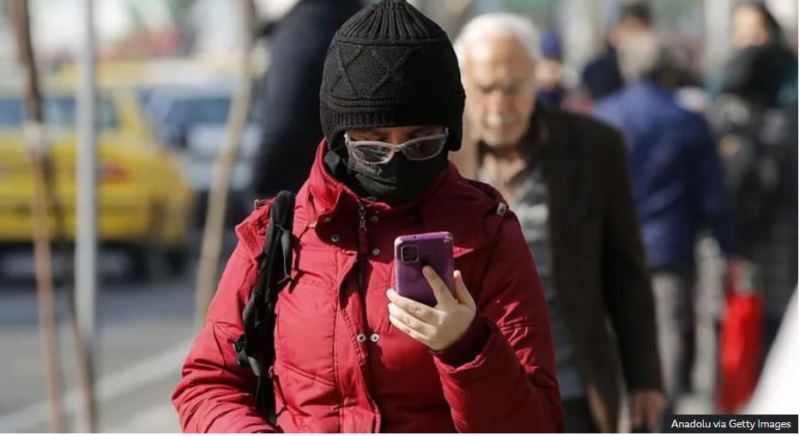
Western media reports says Iranians isolated by a long internet shutdown imposed by the authorities following military strikes by the United States and Israel on Iranian territory.
The BBC reported yesterday that internet monitoring groups Netblocks and Kentik reported “partial” restoration around 13:00 GMT, though the latter warned most networks were still down.
A content creator from Tehran told the BBC that he had been able to connect to the internet using his home WiFi on Tuesday.
Netblocks said it was unclear whether the internet return would be sustained, and told the BBC it was consistent with what it had seen when previous blackouts were lifted – where restoration could take hours.
“Access is not universally back to its original state, with some regional variation,” said the global internet tracker’s research director Isik Mater on Tuesday.
Reuters says the mechanism for how and when Iran would reconnect fully to the global web was not clear, although analysts said the decision to end the shutdown now was likely driven at least in part by the economic impact of keeping businesses offline.
According to Reuters, Iranian Communications and Information Technology Minister Seyyid Sattar Hashemi said on Wednesday that “the Iranian people deserve free communication, a bright future, and a dynamic economy.”
The London-based outlet Iran International reports that Iran’s partial restoration of international internet access after nearly three months of blackout has opened a new fight inside the ruling system, with hardliners accusing President Masoud Pezeshkian’s government of bypassing powerful security and cyberspace institutions.
The dispute reportedly centers on a “special headquarters” set up earlier this month under First Vice President Mohammad-Reza Aref to determine how and when broader access to the global internet should resume after wartime restrictions imposed during the recent conflict between Iran and Israel.
Iran International notes that hardliners have portrayed the body as a parallel institution created to sideline opponents inside the Supreme National Security Council and the Supreme Council of Cyberspace, two of Iran’s most influential policymaking bodies on security and internet governance.
The backlash reportedly intensified after the headquarters voted on Monday to move forward with restoring international internet access.
In response, four hardline members of the Supreme Council of Cyberspace filed a complaint with Iran’s Administrative Justice Court, seeking to halt implementation of the decision and dissolve the newly formed body
Meanwhile, Iran’s state-run IRNA reported on May 26 that Iran has fully restored international internet connectivity across its telecommunications network. According to the report, users of fixed broadband services, including FTTH (fiber to the home), VDSL and ADSL, can now access the global internet without restrictions and use international websites and online services normally.
Iran restricted international internet access on Jan. 8 when nationwide demonstrations over economic issues, including the sharp depreciation of the rial, escalated into clashes that caused casualties and damage to public property. Tehran blamed the unrest on the United States and Israel.
After weeks of blackout, international internet access was returned to normal for a while, but restrictions were reimposed on Feb. 28 when the United States and Israel launched joint attacks on Iran.