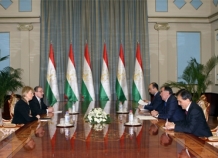
DUSHABE, March 11, 2015, Asia-Plus — On Wednesday March 11, Tajik President Emomali Rahmon received Ms. Helga Schmid, the Deputy Secretary General of the European External Action Service (EEAS), who arrived in Dushanbe for participation in a round of the High Level EU-Central Asia Security Dialogue.
According to the Tajik president’s official websites, they discussed issues related to further expansion of cooperation between the countries of Central Asia, including Tajikistan, and the European Union on the security issues.
In the course of the talks, Emomali Rahmon reportedly noted that the European Union cans see Tajikistan, which is the first line of defense in the fight against modern threats and challenges, as a reliable partner in the region.
Ms. Schmid, for her part, highly appraised a role Tajikistan in providing stability and security in the region and establishing peace and accord in Afghanistan.
The EAS deputy secretary-general noted that the European Union is ready to assist the Central Asian countries to provide security in the region.
The sides reportedly also exchanged views on implementation of new EU-supported projects aiming to help provide security in the region.
The European External Action Service (EEAS or EAS) is a European Union (EU) department that was established following the entry into force of the Treaty of Lisbon on December 1, 2009. It was formally launched on December 1, 2010 and serves as a foreign ministry and diplomatic corps for the EU, implementing the EU”s Common Foreign and Security Policy and other areas of the EU”s external representation. The EEAS is under the authority of the High Representative for Foreign Affairs and Security Policy (HR), a post also created by the Treaty of Lisbon, whom it assists.
The EEAS manages general foreign relations, security and defense policies and controls the Situation Center. However, although the High Representative and the EEAS can propose and implement policy, it will not make it as that role is left to the Foreign Affairs Council which the High Representative chairs.
The EEAS is unique and independent from other EU institutions, formed by merger of the external relation departments of the Council and the European Commission, sitting outside those institutions and it also has its own independent budget.