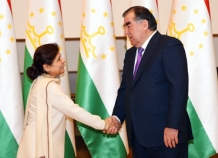
DUSHANBE, February 5, 2016, Asia-Plus – On Friday February 5, Tajik President Emomali Rahmon received visiting United Nations Under-Secretary-General and Executive Secretary of the Economic and Social Commission for Asia and the Pacific (ESCAP), Dr. Shamshad Akhtar.
According to the Tajik president’s website, the two sides discussed a broad range of issues related to socioeconomic cooperation between Tajikistan and the United Nations.
Rahmon, in particular, noted that Tajikistan cooperated with all UN Agencies and appreciated ESCAP’s support for implementation of social and economic projects in Tajikistan.
The two sides reportedly also exchanged views on the outcomes of the high-level international conference on the implementation of the International Decade for Action, “Water for Life”, 2005-2015 and the 10th session of the SPECA Governing Council that took place in the Tajik capital in June and November last year respectively.
President Rahmon and Dr. Akhtar underlined the significance of modernization of automobile highways and railways, enhancement of agrarian sector and development of rural areas, creation of new jobs, construction of power transmission lines and gas pipelines, and implementation of regional energy projects.
They reportedly also discussed priorities for the forthcoming leadership dialogue for Central and North Asia, to be held at ESCAP headquarters in Bangkok on May 17 during the 72nd ESCAP session.
Meanwhile ESCAP reports that Dr. Akhtar is currently meeting with heads of state and government, senior ministers, leading academics and representatives of the private sector across Central and North Asia as part of a mission to deepen collaboration between ESCAP and member nations in the subregion.
ESCAP notes that with a concentration of seven out of the twelve landlocked developing countries in Asia, a central element of Dr. Akhtar’s mission is to focus on the challenges and opportunities of the current economic situation in North and Central Asia, in light of the newly-adopted global 2030 Agenda for Sustainable Development.
Established in 1947, the Economic and Social Commission for Asia and the Pacific (ESCAP), with headquarters in Bangkok, Thailand, is one of the five regional commissions of the United Nations Economic and Social Council, under the administrative direction of the United Nations headquarters. ESCAP has 53 member States and nine Associate members. As well as countries in Asia and the Pacific, it includes France, the Netherlands, the United Kingdom and the United States.
ESCAP”s regional focus is managing globalization through programs in environmentally sustainable development, trade, and human rights. ESCAP will place a greater emphasis on promoting higher, well-balanced and sustainable regional growth that helps eradicate poverty and generates jobs to improve prosperity in the region.
ESCAP works to overcome some of the region”s greatest challenges by providing results oriented projects, technical assistance and capacity building to member States in the following areas: macroeconomic policy and development; trade and investment; transport; social development; environment and sustainable development; information and communications technology and disaster risk reduction; statistics; and sub-regional activities for development.